Category: clarence
Clarence in Paris: Rosa Bonheur

in Parc des Buttes Chaumont
2, allée de la Cascade 75019 Paris
Métro: Botzaris (Ligne 7 Bis)
So I’m not the first self-loathing hipster to wax poetic about Rosa Bonheur, and I certainly won’t be the last. The concept is just so stellar. It starts with one gorgeous, off the beaten path, Parisian park. Buttes Chaumont is surely my favorite public garden in Paris. It seriously makes me feel like I’m in Mirbeau’s torture garden minus all the gore (bonus points if you get that reference, and let’s be friends). This might have something to do with the fact that B erroneously told me that this was a major site for public executions in the eighteenth century (it wasn’t). While not nearly as tightly manicured as the Jardin du Luxembourg or the Jardin des Plantes (my other favorite places to go on a sunny day), Buttes Chaumont makes up for it with traditionally styled English and Chinese gardens. The space began as a limestone and gypsum quarry, leaving the space full of miniature mountains and cliffs that you can climb up to ex(e/o)rcise your inner mountaineer. The park also has a large lake that contains both a grotto with an enclosed 65-foot high waterfall and an island accessible by a 200-foot long suspension bridge (aptly nicknamed the “suicide bridge”). The island itself is a verdant, craggy peak, atop which sits the belvedere of Sybil. Wikipedia informs me that the belvedere was added to the park in 1869 and is a Corinthian-style monument, modeled after the ancient Roman temple of Sybil in Tivoli, Italy. I’ll inform you that it is one of my favorite views in Paris.
Here’s an old timey map of the park:

See that little building called “Pavilion du Chemin de Fer”? Well, since it was a railway outpost had many culinary incarnations, including this one from the nineteenth century:
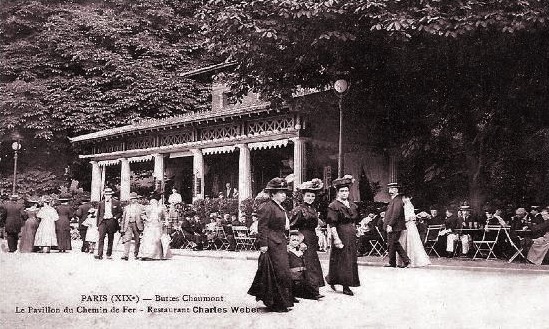
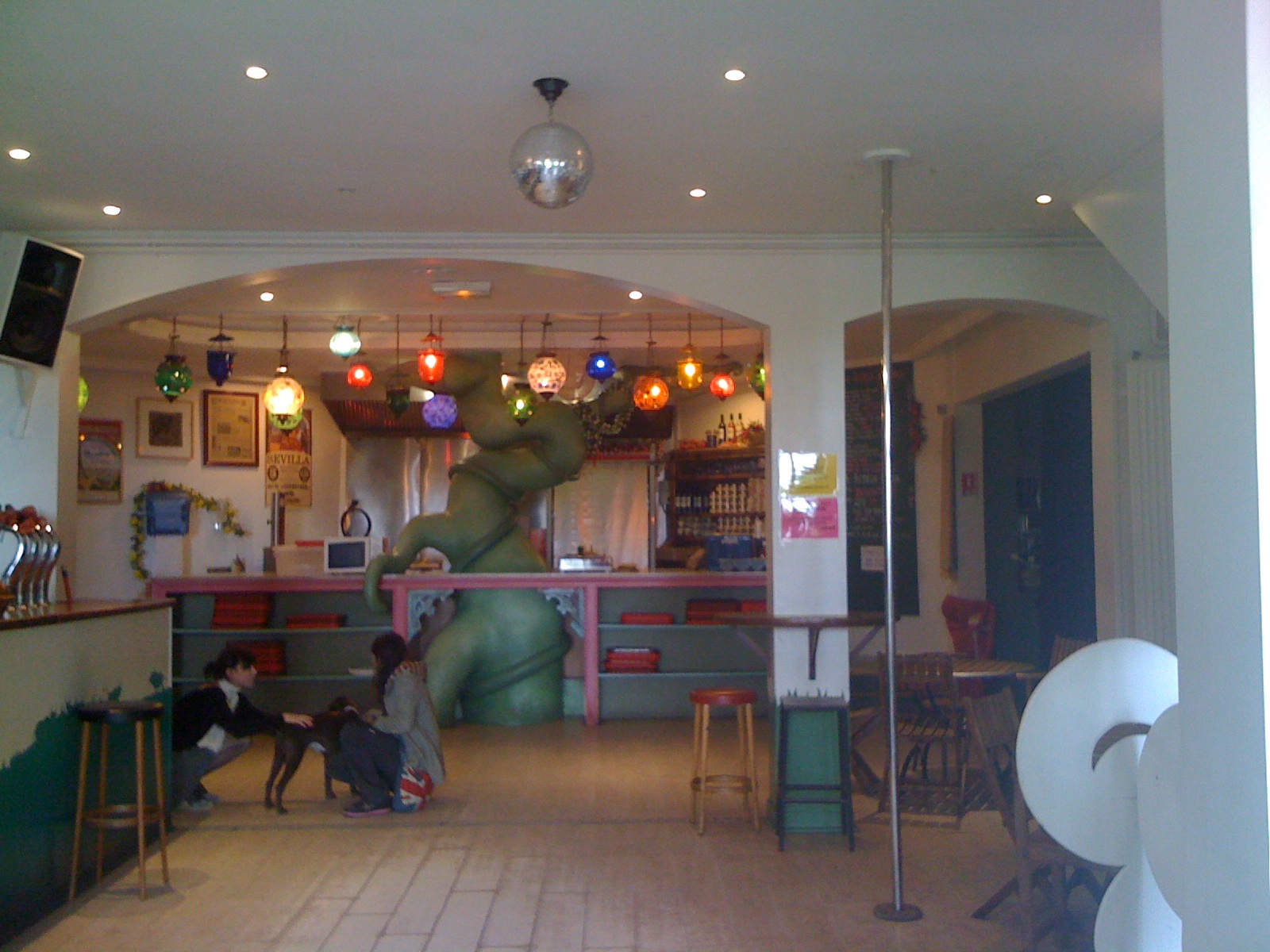
The people at Rosa Bonheur renovated this amazing historic building to be a sort of bobo wonderland, complete with two bars with cheap rosé, yummy snacks, lots of outdoor seating, great music, and a view of the sunset. Here’s the outside in 2010:

And the inside:
The food is built around the wonderfully simple concept that you can eat everything accompanied by a brown paper bag of freshly sliced baguette. On a recent visit, our spread looked like this:

Clockwise from the top, that’s an aged comté, slices of spicy chorizo, black olive and fig tapenade, dry sausage, and a lovely jar of duck rillettes. At a couple of euros for each component with a big bag of bread, you can put together quite a picnic. Pair that with some cold beers or a bottle of rosé and you’ve got yourself a nice lazy afternoon.
The logistics are kind of heavy on this place. First of all, the park itself is on the bizarre line 7 bis, a one-way, miniature subway line complete with a short train and a maddeningly slow schedule. B refuses to even take it and insists on walking from Jourdain on line 11. I’d recommend instead that you suck it up, take the 7 bis, and get off at Bozartis. As you exit the métro, the park will be on your right hand side. Walk up about a block to the entrance, then veer left on the path about another block to Rosa. You can obviously enter the park anywhere, but it can sometimes be quite a hike to get to Rosa if you start at the bottom of the hill. You can think of it as earning those rillettes.
My favorite time to go to Rosa is in the afternoon, as it is bar none one of the best places to laze away with friends on a sunny day. The park gates close at 7 p.m. and Rosa becomes kind of a scene, with hoards of Chuck Taylor and tortoiseshell glasses clad hipsters waiting at the gates to be slowly let in by an unamused park security guard. So if you want to go there for the evening, just show up at six so that you can get in to the park without a wait. Try and snag one of the tables to your right as you enter the restaurant if you want a killer view of the sunset and the envy of the coolest kids in Paris.
Details: I think I’ve covered it, though Rosa also has a very comprehensive website, from which I lifted both the map and the old photo of the pavilion. Sometimes their hours get funky with the change of the seasons or private events, so it’s worth visiting their website or Facebook page if you are planning a visit. On another note, it’s a very friendly place for kids and dogs, both of which run around in joyous abundance.
Clarence in Paris: Higuma
32 bis rue Saint Anne, 75001 Paris
Métro: Pyramides
Oh, that’s right, I have a blog.
Don’t think for a second I forgot about you, dearest reader. In fact, I would describe the past two weeks as being consumed with “gnawing guilt” that I’ve neglected you so throughly. Well, gnawing guilt and finals time at the university where I teach and a steady stream of visitors from all over the place. It also got hot, suddenly, and I’m worthless when I’m sweaty. Any kind of weather extreme and I lose all desire to do anything other than sit around and complain about how uncomfortable I am. I’m a real charmer.
One thing that has kept me rolling the past month or so has been the discovery of Higuma, the Japanese ramen place that I fantasized might exist in previous entries. The Little Tokyo area of Paris is rather oddly located in the heart of the first arrondissement, so if you find yourself barfed onto the street with the rest of the hoards after the claustrophobia-inducing exercise that is touring the Louvre, I would highly recommend that you skip all the overpriced “French” tourist traps in the area and instead head to rue Sainte Anne for some noodle-based fortification. You won’t regret it.
My friend S (now temporarily bereft of H) had highly recommended Higuma as he often frequents it when he stays in a gorgeous apartment owned by family friends on the same block (color me virescent with drooling envy). Sainte Anne is packed with terrific-looking sushi and noodle shops, many of which attract lines that would suggest that good cooking is afoot. The line is always longest at Higuma, however:
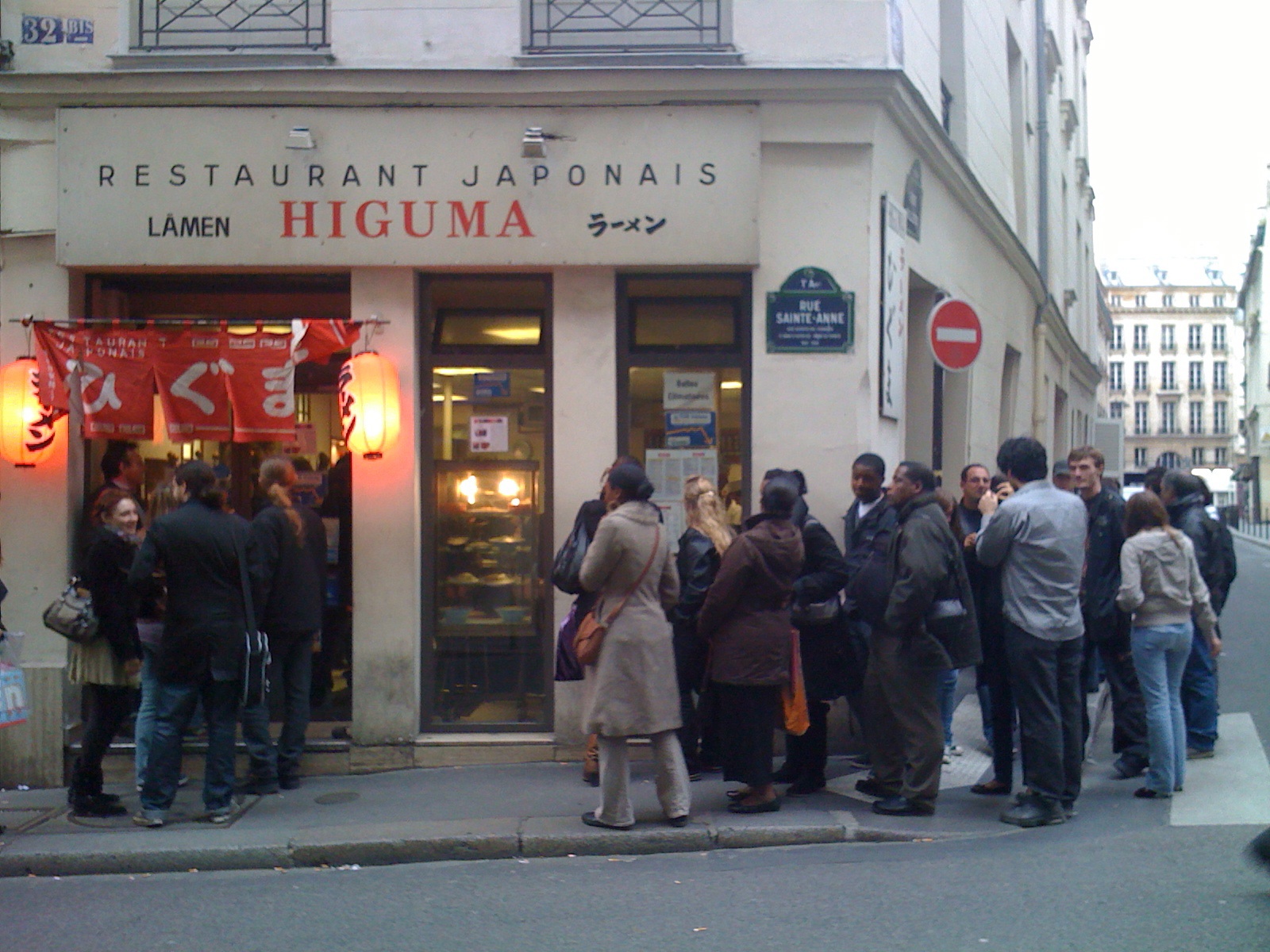
But it moves fast! Really fast, actually, as this is one of the few places in Paris where puttering around over your empty plates is highly frowned upon by both the staff and the line of famished patrons who watch you slurp every last noodle.
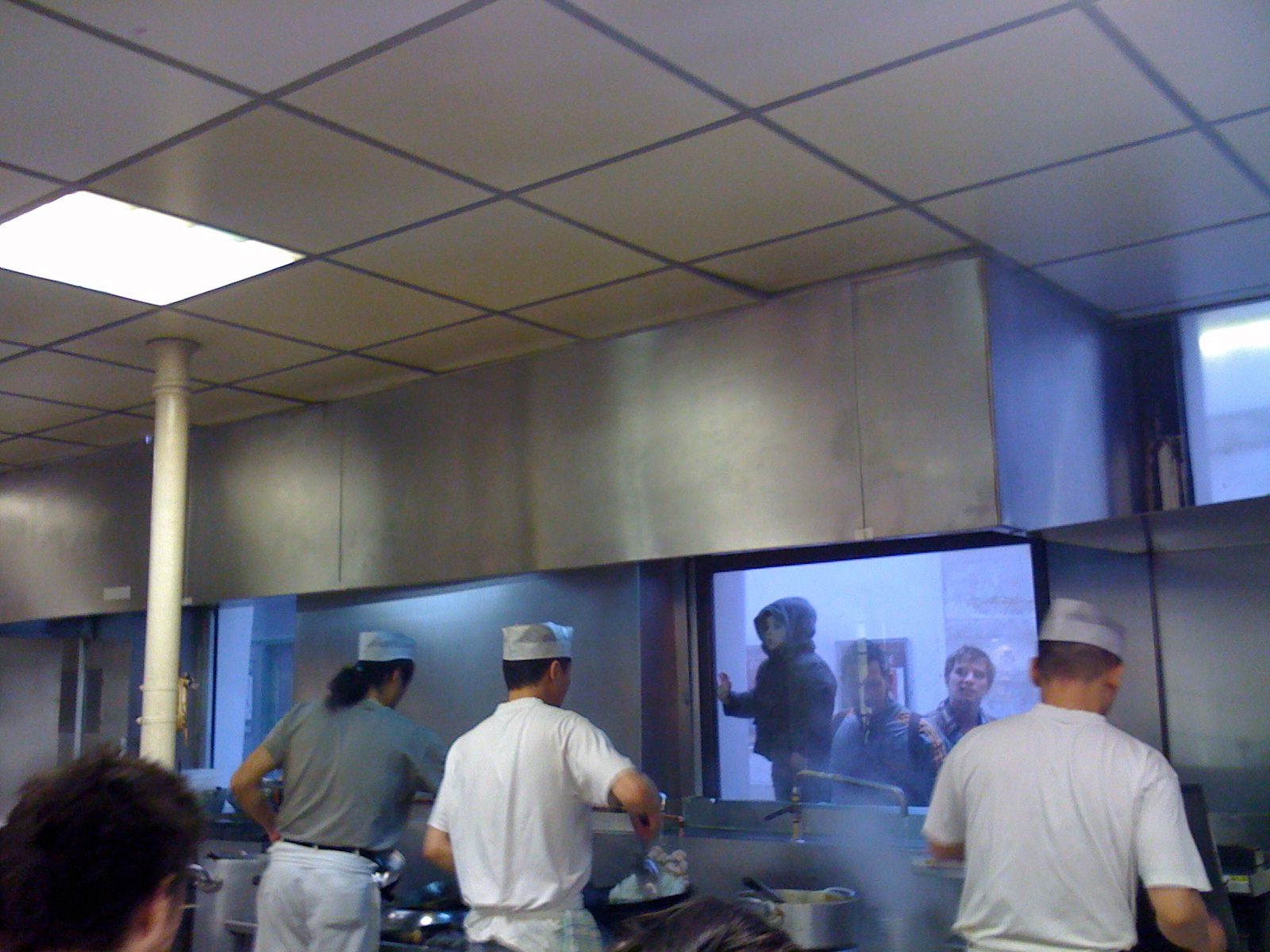
As you can see, the front dining room is dominated by the open kitchen, where you watch skillful chefs with seemingly fireproof hands and faces prepare your food. As far as I’m concerned, watching my meal come to life is the most entertaining show imaginable. Some internet naysayers complain that you leave Higuma smelling of meaty smoke and pungent spices. Yes, you do. I can’t think of a more delightful thing to smell of. I can just imagine this high maintenance chick who is worried about her blowout smelling like ramen. Trust me, sweetie, that hot guy at the bar would rather you smell like pork than tropical flower cotton candy any day of the week.
The first time we ate at Higuma was at around 6 p.m., a weird time for Parisians to eat so found the place nearly empty (good advice for people like my mother who are congenitally incapable of waiting in line for long periods of time). B and I decided to try some ramen before we went to the Deerhunter show at La Maroquinerie. While I can’t say much for the study-abroad crowd attracting, vaguely monotonous stylings of Deerhunter, I can say that another delightful discovery of the evening (besides Higuma) was the opening act, a lovely woman who—with a set of laptops—goes by Bachelorette and makes dreamy fun electronic pop. My favorite cyborg moment so far of the year was when she announced in her little voice “We are Bachelorette, me and the laptops. (Pause). Nous sommes Bachelorette!” Love love this lady, check her out. “Donkey” has totally been my jam for the past few weeks.
Back to the food. Sorry.
So there’s of course the ramen (spelled ‘lamen’) and it’s all things you want ramen to be: vaguely fatty, salty, hearty, and rich. Pictured is the miso lamen (6.50€), which has a nice mellow character to it:

I’d also recomment the shio lamen (6.50€), which is a great basic vehicle if you are like me and tend to douse your noodles with every condiment available on the table (in this case, a delightfully piquant chile oil and the requisite orangey MSG powder). I wouldn’t recommend the syoyu ramen (6.50€), as its soy-sauce based broth is a bit too salty for my taste (and my palate can handle a veritable sodium bonanza on occasion).
A lovely option (and a real “feeder” as my pops would say), are Higuma’s menus (10€), which include a main dish as well as an entrée. Worth their weight in pan-fried gold are these delicious little pork and veggie gyoza:
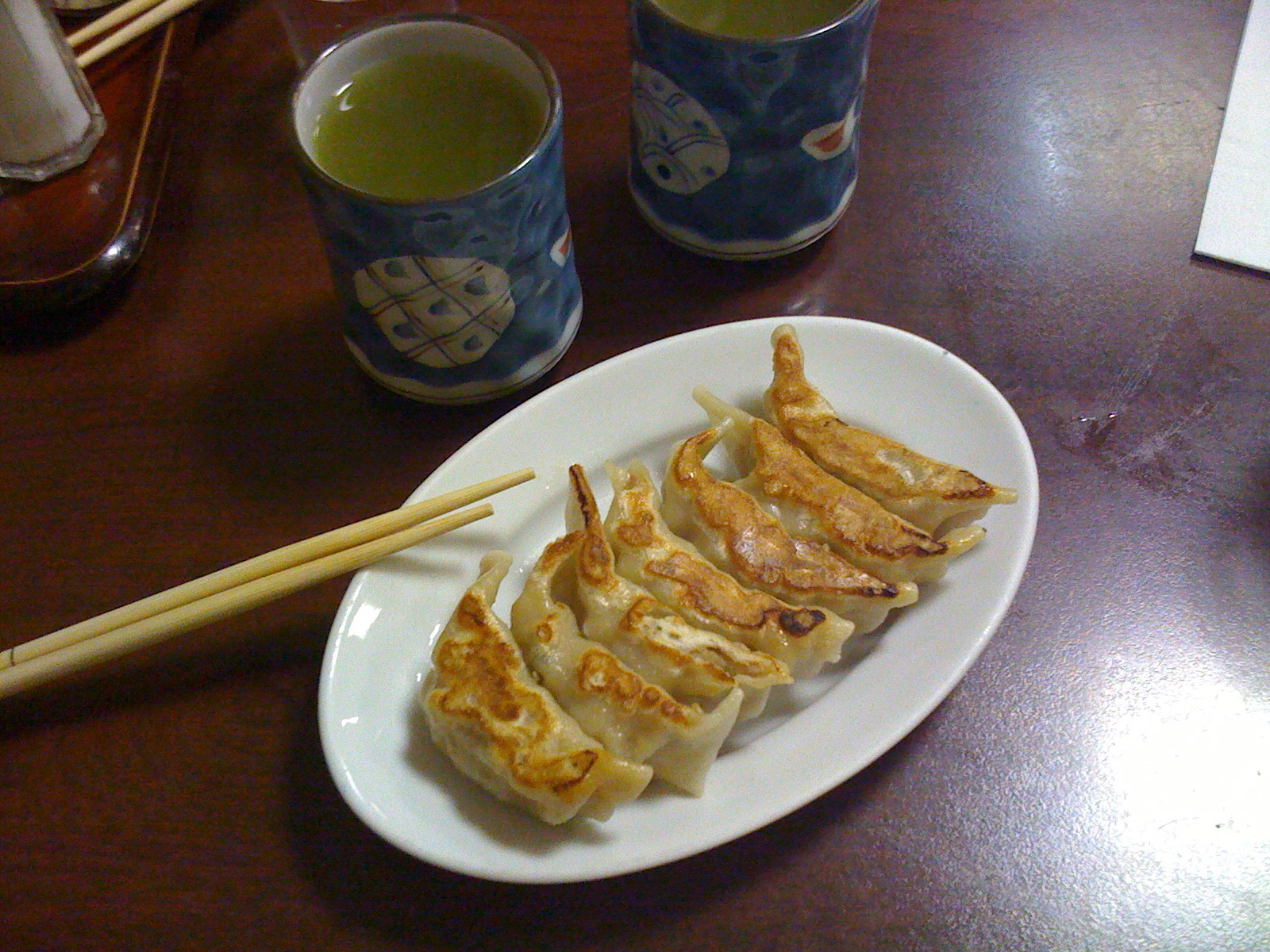
If you live back in the States and have a Trader Joe’s nearby, you surely know the joy that is having a freezer full of gyoza for your snacking pleasure. God I miss Trader Joe’s. Good gyoza are rather rare here in Paris and should be savored. Twice now at Higuma B’s gyoza have become communal property, and while he is too nice of a guy to admit that he doesn’t want to share, I can see a deep sadness in his eyes when everybody digs in to his dumplings. Sorry kid.
There are also some really toothsome rice dishes, including this katsudon (8€) of pork, onions, and egg over fried rice, pictured with a mediocre miso and a most interesting pickled radish thing:

I’d also really recommend the chahan (8€, also available in a menu as half portion with your choice of ramen for 10€). I don’t have a picture, as I forgot my camera that particular time. This pork, shrimp, and veggie fried rice dish doesn’t look like much when it arrives, but it is the apex of buttery, fatty, fried rice goodness. I ate nearly all of B’s portion when he ordered the chahan menu. Poor guy, he can’t even keep his food on his plate when Clarence is hungry.
I know you are already chomping at the bit to go to Higuma, but I haven’t even told you about the best part yet. And by “best” I mean consciousness-altering, game-changing, oh-my-god-where-have-you-been-the-past-rainy-six-months-of-my-life delish:

This is some serious yakisoba (7.50€) people. Tender pork, even tenderer calamari, oyster mushrooms, sautéed vegetables, grated ginger, and fried noodles in a spicy, salty, oh-so-heavenly sauce. This dish is umami personified. Variety be damned, I don’t plan on ordering anything else, ever.
Details: There will be a line, but do you really have anything better to do? Meals are cheap, cheap, cheap, especially for that area of town. Beer is less cheap, but split a giant Sapporo with your date and spend the rest of your boozing money on extra gyoza. Open late and every day of the week. Done and done.
* * *
Addendum: My friend T–a first-order Japanophile, Paris denizen, and generally swell guy–had quite a mouthful to say about this post. As he posted it on Facebook instead of the blog, I’m pasting it below. If there is anybody who has done his homework on Japanese food in Paris, it’s certainly him.
Higuma is pretty good, especially given the price, but you should definitely try Kunitoraya, the restaurant with the wooden facade just across the street and South a few metres.
I find the quality of the food to be much better (the katsudon is quite good), and, while I generally prefer ramen to udon, the udon at Kunitoraya is fantastic. Everything is super authentic (down to the staff, who barely speak French or English). It costs slightly more, but it’s definitely worth it. Their oden (which I suspect won’t be available in the summer) is also wonderful.
The butter corn ramen at Higuma (as strange as it sounds) is pretty good. It’s fairly popular in Hokkaido, and it only makes sense to make it with delicious French butter (though Ben will surely be disappointed by the corn).
(FYI: the orange spice blend is 七味唐辛子 (shichimi togarashi), and is MSG-free — in case anyone has an aversion to MSG.)
Whew. Consider me schooled.
Clarence in Berlin: Rogacki
Wilmersdorfer Str.145/46
10585 Berlin-Charlottenburg
U-Bahn: Richard-Wagner Platz
My wonderful friends C and D happen to live in the Charlottenburg area of Berlin, only a few blocks from Rogacki, making them the luckiest people in the world. When we all first arrived in Berlin in 2008, a visit to Rogacki for lunch seemed super-special. Now C and D are decidedly blasé about their culinary good fortune: “Oh, hey babe, can you pick up some bread from Rogacki on your way home?” “Oh, hey babe, can you swing by Rogacki and get some of that sausage I like?” You would think they were talking about any old grocery store, not a national treasure.
So what’s the deal? Rogacki is straight-up German delicatessen heaven. Gorgeous baked goods, cheese, meat, and fresh fresh fish counters in the front, with heavenly prepared foods in the back of the store along with a cafeteria-style restaurant. We’re talking a serious stretch of pickled fish phantasmagoria here, people. One of my favorite Rogacki specialties is the pickled mackrel rolls stuffed with vegetables. While a ubiquitous Deutch treat, at other places the veggies are often limp and the mackrel too fishy. Never ever at Rogacki, where the fish is always tender and flakey and the veggies crunch like a perfect pickle:


The cafeteria is a huge draw. It seems like the crowd favorite is the killer deep fried battered white fish (halibut? cod? Mein Deutsch ist schlecht) served with a choice of one of three German-style potato salads (this means tart, salty malt vinegar is the binder, not mayonnaise). It’s an amazing plate of food, and like everything else it will set you back less than six euros:

Unfortunately, I never end up with more than a bite of the fish because when I’m at Rogacki, I’m going for the big guns:

That’s a straight-up divine plate of Blutwurst (blood sausage) and Leberwurst (liver sausage) nestled in a bed Sauerkraut and whipped potatoes. I have concocted untold number of lurid fantasies about this dish during my food porn time. As we walked to Rogacki during my visit to Berlin a few weeks ago, I was panicked and sweaty with anticipation of my treat. I could barely handle looking at the other parts of the store before ordering. The store was about to close (they don’t really do dinner) and for a minute it looked as though the Blutwurst had been put away. I almost cried. Fortunately, the kindly Rogacki employee understood that this wasn’t just a wurst, this was holding the addict back from their visit to the methadone clinic. My needs were accommodated, much to my abundant glee.
There’s few things that I would describe as a MUST-DO should you ever visit Berlin, but Rogacki is certainly one of them. The lovely, low-key neighborhood that surrounds it isn’t necessarily on many tourist itineraries, but you could make a lovely afternoon of lunch at Rogacki followed by a visit to the Schloss Charlottenburg or the Museum Berggruen. The largest castle in Berlin, the Schloss Charlottenburg is a great specimen of Baroque and Rococo style with sprawling grounds that are free to the public. The Museum Berggruen has one of the most dazzling collections of Modernist art in Europe, including a veritable clusterfuck of impressive Picassos. But, let’s be frank, with a belly full of the delights you’ll find at Rogacki, the rest of the day is just icing.
Details: Busy, busy all the time, but busy, busy, busy at lunchtime. I like to go in the late afternoon, but caveat emptor, when they run out, they run out (unless of course you start hyperventilating at the prospect of not eating Blutwurst, in which case accommodations might be made). Open Monday through Wednesday from 9-6, Thursday from 9-7, Friday from 8-7, and Saturday from 8-4. Don’t even think about visiting Berlin and not making a stop here. I’m talking to you, Ms. M.
Photos courtesy of C and D. Like M’s photography, I think this post is proof positive that a decent camera and an actual eye can go a lot further than my usual nonsense. You can follow C and D’s enviable life at D’s great blog 50 percent of my DNA. D’s got a lot to say about expat living and she does it with much more wit than I can ever muster. Bonus: you can see many pics of C and D’s sweet, smart, and funny kid B, my favorite child in the world bar none. I can only go to D’s blog so often, because it sends my ovaries into throbbing overdrive.
La Chasse
A few weeks ago I walked in on B looking at something very intently on my computer. Beads of sweat had formed on his brow. He looked up at me guiltily and I discovered that he is interested in a very peculiar type of website:

Mushroom porn.
Or more precisely, morel mushroom porn. See, B grew up hunting morels in the forests of Indiana. Apparently, there are all sorts of backwoodsy folks in the US who do this sort of thing, and some of them reap the benefits fit for a king.
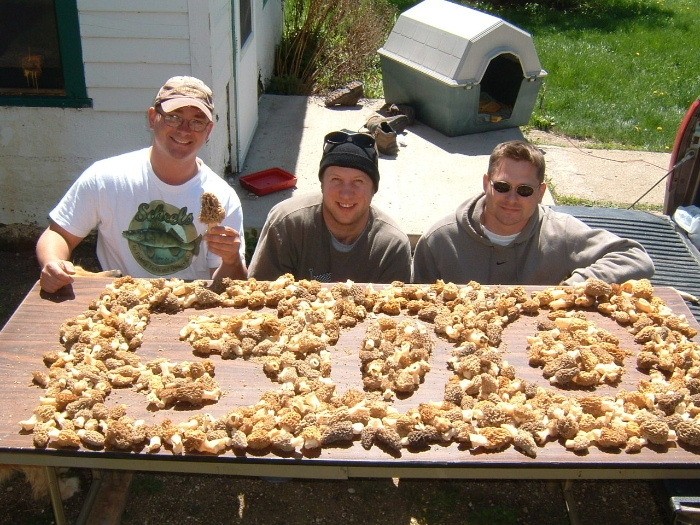
I joked that B had far too many teeth and far too little camouflage to consider these people his brethren. This apparently hit a nerve and he was explained to me in no uncertain terms that morel hunting, like lung cancer, is a proud part of his Hoosier upbringing. Over the past month or so, he has become increasingly obsessed with the forests surrounding Paris, weather and soil conditions, French morel hunting message boards, and where the morels originate that have been arriving at the Marché des Enfants Rouges (answer: Turkey). He’s developed what I’ve begun calling “the manic morel face,” a combination of childlike Christmas morning excitement grin with the deranged eyes of a pedophile.
So yesterday, some of us went out to Fontainebleau with the idea of hunting for morels. We packed quite an epic picnic. I did my part by spending a small fortune at the cheese counter at La Grande Epicerie, a decision that made me the most fragrant participant in la chasse. Long story short, we didn’t have any luck finding morels, but we did have a lovely afternoon drinking rosé, sunbathing, and exploring a beautiful forest. We also saw this:

Yes, that’s a swan nesting in front of the chateau. M snuck onto the grass to capture this shot, only to have a small band of authoritarian children gather at the edge of the trail and hiss “Pelouse interdite!” (“Grass is forbidden!”). Their terrifyingly early internalization of the Law was hysterical, and we spent the rest of the day joking about p’tits collabos. A great day all in all, though I wish I’d snuck a basket of morels in my bag to hide under trees for B. I’m sure that a seasoned morel hunter like him wouldn’t have been fooled for a second, but it might have taken the edge of the disappointment that overtook his face as the day progressed. I’ve been informed, however, that la chasse has only just begun. As Clarence is a big fan of a morel cream sauce on his filet mignon, I suspect that there are a few trips to Fontainbleau in my near future.

Clarence in Berlin: Brunch
There has suddenly been a ton of Google searches concerning Salò arriving at this here blarg. B conjectured that this was because it was Sunday, and Acattone screens Salò on Sunday nights, so maybe people were just looking for the showtime? I feel like I really haven’t written nearly enough about Salò to warrant this interest, though I wish I had. Dearest reader who is interested in Salò, have you read any Leo Bersani? I think his “Merde Alors,” published in October in the summer of 1980, is the best thing anybody has ever written about Salò. Like, ever. I’d link to it on Jstor, but you might not be a terminal student like myself with an academic subscription. If you e-mail me, however, I’ll be happy to send you a PDF.
Here’s a teaser:
Narrativity sustains the glamour of historical violence. Narratives create violence as an isolated, identifiable topic or subject. We have all been trained to locate violence historically—that is, as a certain type of eruption against a background of generally nonviolent human experience. From this perspective, violence can be accounted for through historical accounts of the circumstances in which it occurs. Violence is thus reduced to the level of plot; it can be isolated, understood, perhaps mastered and eliminated. Having been conditioned to think of violence within narrative frameworks, we expect this mastery to take place as a result of the pacifying power of such narrative conventions as beginnings, explanatory middles, and climatic endings, and we are therefore suspicious of works of art which reject those conventions. In short, we tend to sequester violence; we immobilize and centralize both historical acts of violence and their aesthetic representations. A major trouble with this is that the immobilization of a violent event invites a pleasurable identification with its enactment. A coherent narrative depends on stabilized image; stabilized images stimulate the mimetic impulse. Centrality, the privileged foreground, and the suspenseful expectation of climaxes all contribute to a fascination with violent events on the part of readers and spectators. As Sade spectacularly illustrates, the privileging of the subject of violence encourages a mimetic excitement focuses on the very scene of violence. All critiques of violence, to the extent that they conceive of it in terms of scenes which can be privileged, may therefore promote the very explosions which they are designed to expose or forestall. (28-9)
B just pointed out that I’m probably soliciting contact from a really fucked-up person. But there are just so few of us out there, yanno?
You know how Jim Gaffigan does that thing where he mimics the interior monologue of his audience members? I suspect that my reader’s interior monologue sounds something like this right now:
Oh my god, stop talking about that stupid movie. Nobody cares about Pasolini! We didn’t sign up for some academic blog! We want to hear about brunch in Berlin!
Oh, all right, twist my arm.
* * *
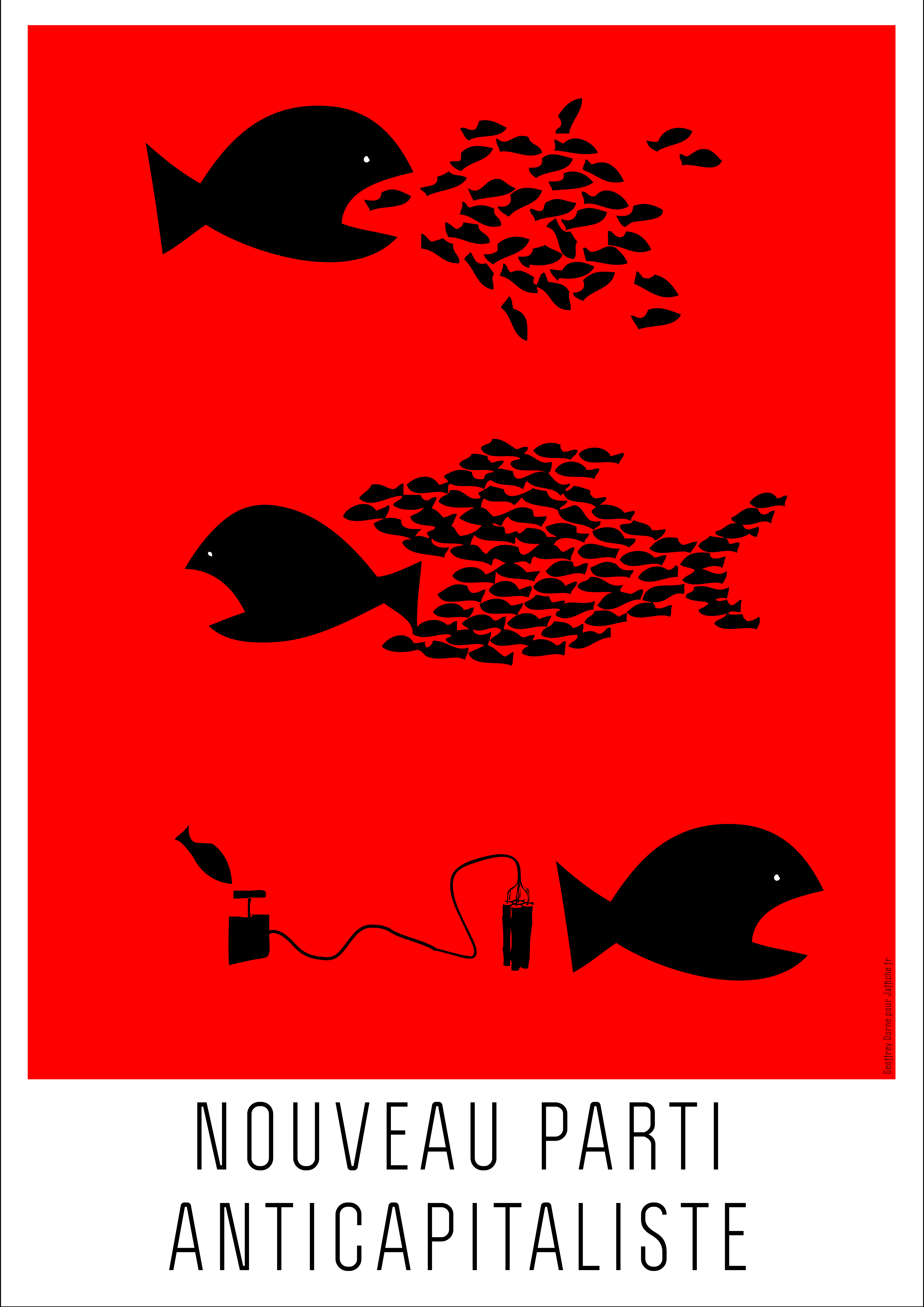 I feel like waxing on about how much I love brunch will probably topple this blarg into such unabashedly bourgeois bohemian territory that the Nouveau Parti Anticapitaliste will never accept my application. To be fair, my primary interest in being a member of the NPA stems from their most excellent graphic design, so my motives are already highly suspect as far as they are concerned. But anyway, here we go: I love brunch. You kinda knew that already, didn’t you? Any activity that involves sleeping in, boozing during the day, sitting outside in the sunshine, talking shit with my friends, and eating things doused in Hollandaise was likely to be my bag. And I’ll make a controversial argument here and now: Berlin is the best city in the world for brunching. Now I know all you New Yorkers are getting your underwear in a wad right now, but hear me out. I’ll concede that New Yorkers understand brunch and have institutionalized brunch in a way that I totally love. Los Angelenos don’t understand brunch. It involves too much laziness and not enough striving-to-be-famous. Everybody at brunch in LA is always just stopping through on their way to an audition or Bikram yoga class. Steve Martin got it right, brunch in LA is always something like this:
So New York beats LA on this one, hands down, but New York brunches are expensive, or at least compared to Berlin. Now Paris brunches make New York brunches look like Denny’s. My neighborhood is full of 28 euro brunch buffets, and that doesn’t include coffee. I think that is about eighty-seven dollars at current conversion rates. I don’t care what you say, it’s still funny, even if the euro is tanking under a huge cloud of volcanic ash.
 Berlin brunches are on Sunday are cheap, lazily paced, and often are an all-you-can-eat buffet. My two favorite buffet brunches in Berlin are at Bellaluna (Kollwitzstraße 66, U-Bahn Senefelderplatz) in Prenzlauer Berg and Café do Brasil (Mehringdamm 72, U-Bahn Mehringdamm) in Kreuzberg. At both you can eat yourself stupid on delicious things for less than 10 euro (at Café do Brasil, this includes all the coffee you can drink). And don’t you dare think that this is some kind of Country Buffet operation. We’re talking beautiful spreads of pastries, fruit, cheese, charcuterie, and smoked fish. At Belluna—which also makes killer pizza the rest of the week—you can also expect to see a variety of pasta dishes. One day there was a cold seafood salad of calamari, shrimp, clams, and mussels in pesto. I almost died. If you are sick to death of European food, Café do Brasil adds amazing Brazilian-style meats to the standard mix. The best advice I can give you for any delicious Berlin brunch locale is to arrive early and to be prepared to wait. This city takes brunch seriously.
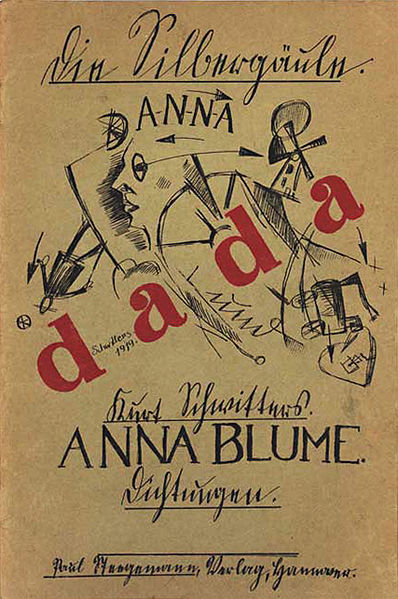
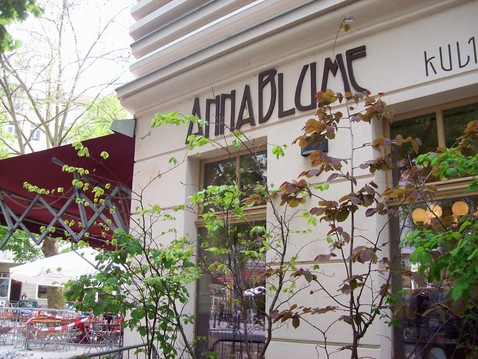 My trip to Berlin didn’t involve a Sunday brunch, much to my chagrin. My amazing hostess D made it up to me, however, by suggesting on our first day that we stroll around darling, bobo Prenzlauer Berg and have brunch at my ever-after favorite, Anna Blume (Kollwitzstraße 83, U-Bahn Eberswalder Straße). Named for one of my favorite Dada poems by Kurt Schwitters, Anna Blume is a combination cake bakery, flower shop, and heavenly restaurant. They have rosemary honey ice cream here, people. There are fleece blankets on their abundant outdoor seating, so if it’s chilly you can wrap yourself up. And the breakfast towers, oh, the breakfast towers! Three tiers of cheese, charcuterie, scrambled eggs, homemade gravlax, roasted vegetables, fresh fruit, seasonal preserves, pastries, and baskets of fresh bread. I suspect I’d even feel warm and friendly breaking bread with Glenn Beck if there was an Anna Blume breakfast tower between us. If you don’t go for a breakfast tower, can I just recommend that you try the Anemone plate? The aforementioned gravlax-of-pure-unadulterated-bliss is paired with a heap of sweet, tiny shrimp in a cream sauce, pickled onions and gherkins, some kind of whipped creamy cheese concoction, warm slices of dark pumpernickel bread, scrambled eggs, fresh fruit, salad, and strawberry preserves. Or you can try the Oleander plate, with it’s heaps of Italian charcuterie, bufala mozzerella, and roasted vegetables. Or perhaps you are like my friend D, who is seven months pregnant with a iron-hungry little carnivore. She looked positively rapturous over her meat-
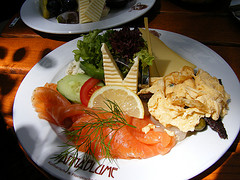 laden Alpenrose plate, which boasts some tiroler schinken worthy of your unborn child. Whichever way you go, it will be perfect and under 8 euros. You’ll have to go to Berlin and get one yourself. I’ll be in Paris, hemorrhaging cash and dreaming of that smoked salmon.
Tomorrow, Clarence will let you in on his favorite French, Vietnamese, Indian, and (gasp!) Mexican eats in Berlin. Suspend your disbelief!
 The Bear-Garden