Category: clarence
Hungerdome: Will “la vraie gastronomie mexicaine à Paris” please stand up? (part one)

I bet you thought I forgot all about you.
I won’t bore you with a tedious account of what I’ve been up to, other than to say, man, writing a dissertation is really hard. Once I’ve stared at the blinking Word cursor for hours doing that, it’s really tough to get motivated to write a blog entry that isn’t just like “whine, whine, whine, woe is me, I’m the pitiful scholar.”And is there anything more grating than listening to a graduate student bitch about their “work”? It’s annoying whenever anyone complains about their deadlines and their stress level, but there is something uniquely agitating about it when that person is a graduate student. I slept until eleven today, people. I don’t get to complain about my life, like, ever. So I won’t, and anyway, I’m sorry to be such a deserter.
ON TO BRIGHTER THINGS:
We’ve been eagerly awaiting the French release of Carlos Cuarón’s Rudo y Cursi, starring the überdreamy Gael García Bernal and Diego Luna. A quick gander at IMDb suggests that everyone in the entire world who has wanted to see this movie has probably already seen it, as the French release date was the very last one in the list of international premieres. That said, if you haven’t seen it, you really should. It’s fantastic. We’ve been giddily anticipating it, being big fans of everything Gael García Bernal does, from his acting right down to his face sweat. Seriously, I love that man like a sickness. Jarmusch’s The Limits of Control left me with months of sweaty Mexican cowboy dreams. Recently, I rather uneasily discovered that B’s enthusiasm for Gael rivals my own, and couldn’t help but wonder who both of us imagined we were making out with after the movie last night.

At any rate, we decided that Rudo y Cursi demanded a fully Mexican-themed evening, so we made reservations at Hacienda del Sol (157 bd du Monparnasse, 75006 Paris, Métro Vavin), one of two Mexican restaurants in Paris that receives a fair amount of gastronomical acclaim. I had first read about it on the New York Times’ In Transit blog, where it was lauded by someone who was supposedly originally from California (had it been a New Yorker, I would have ignored it entirely). It’s kind of a trek from our place in the Marais down to Montparnasse, but this is the way that Gael would want it, we reasoned.

I’ll cut immediately to the chase: the food is pretty good! If you are a European, you’ll probably totally dig it. If you are an American in Paris, or god forbid, a Mexican, I’d give yourself about a year in Paris until you start checking out restaurants that advertise themselves as “la vraie gastronomie mexicaine.” By then, you’ll be so psyched to see Bohemia and Negro Modelo on the menu that you won’t even blink at the fact that they cost as much as a few six packs in the States.
I guess that part of my problem stems from the fact that Mexican food seems like it shouldn’t ever be fussy, and Paris isn’t particularly good at doing anything that isn’t fussy. There are a few (wildly popular) exceptions to this rule, including the abysmal Ave Maria (1 rue Jacquard, 75011 Paris, Métro: who cares, the food is terrible), where huge sloppy platters of the equivalent epicurian value as “world music” are eagerly gobbled up by the “sophisticated” palates of the French hipster public. Hacienda del Sol is marketing itself as a refined take on Sonoran food, and I suppose that is how you’d have to market yourself if you wanted to make a living in this town. But for an American accustomed to big bottomless baskets of hot chips and sloppy bowls of spicy salsa, the tiny dish of cold chips and the miniature spoon that accompanied our little puddle of hot sauce felt, well, heartless. As did our kindly server’s warning that our salsa was “dangerously spicy,” which I suppose it is, if you’re French.

For our entrées, we shared a serving of (rather bland) guacamole and some beef chimichangas. The presentation cracked me up, because, really, chimichangas? This is a food item that I associate most clearly with the microwave at a gas station. They were pretty good, I guess.
I’m terribly homesick.

For our main course, I got the pollo en salsa de mole poblano and B got the tamale plate. My chicken in mole was quite good, even if the mole wasn’t quite as spicy as I’m used to it being. The flavor was nuanced with that medley of sweet and smoky that I love, and the corn tortillas were fresh and homemade. Yes, those are bananas, not plantains. Sigh.
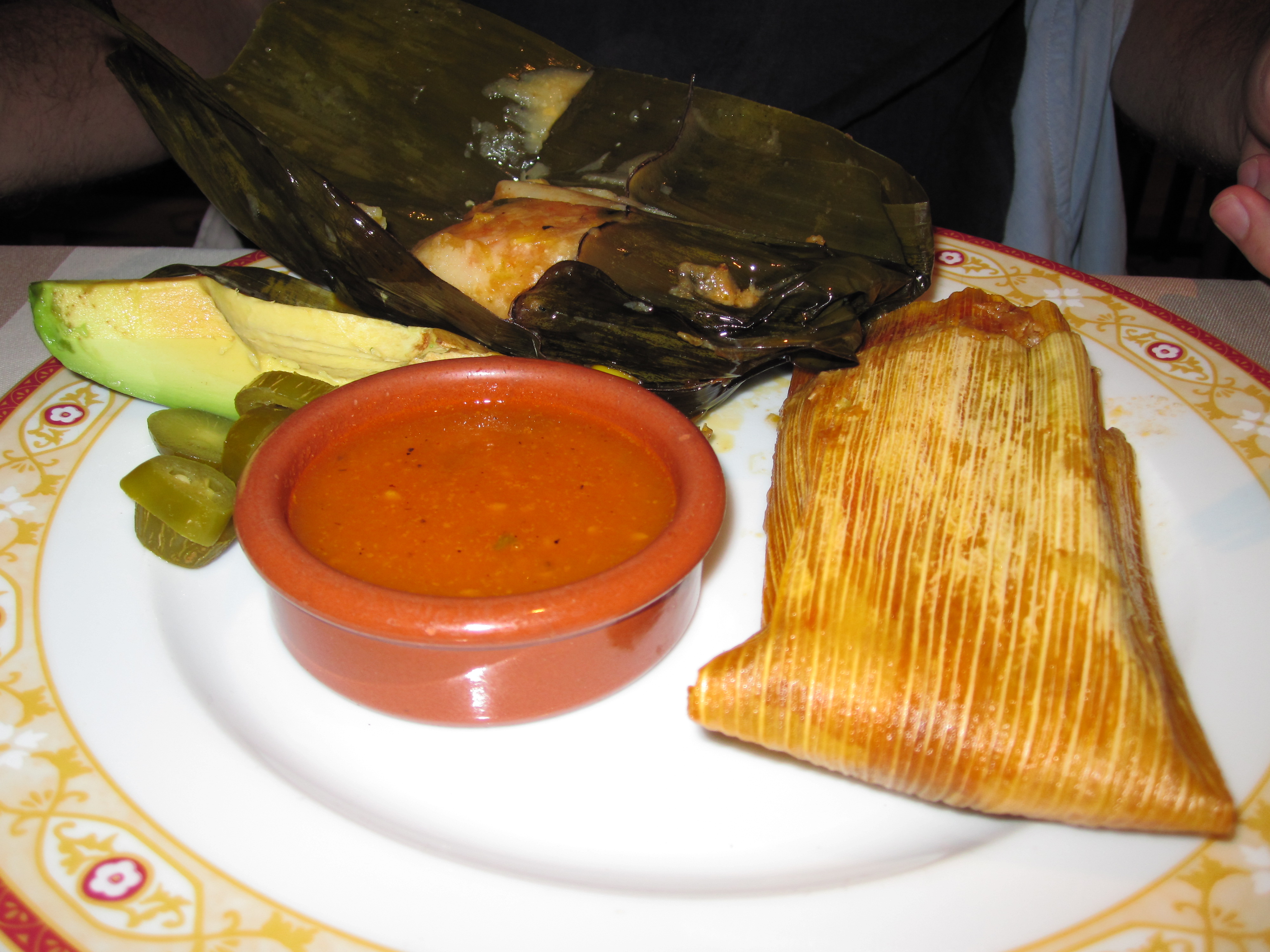
Even better were B’s tamales, one filled with tomatoes, cheese, and roasted chiles in a banana leaf, and one filled with red chile cooked beef in a corn husk. I was immediately overcome with jealousy when they served our plates, and wished that we had both ordered tamales and been done with it. They were tender, flavorful, and moist, and I wished that the two bites B generously doled out could have been bigger. In an ideal world, I could have smothered them in Chimayo red chile sauce and made a glorious feast, but we’re in Paris, and they got the job done admirably.

For dessert, we shared a dish of ice cream, which our server proudly noted is made in-house. We selected scoops of tamarind, hibiscus, and lime, and the combination was perfectly sour and refreshing.
The only thing that soured the meal a bit for me was the check. Look, I get it. Many of these ingredients have to be imported from across an ocean. The 29€ menu of entrée + plat + dessert is indeed the magic number in this town. But 76€ for a meal that involves chimichangas and Mexican beer? That’s $96.32 as of today’s conversion rate. When I pointed out to B that were spending about a hundred bucks on this dinner, he turned slightly pale. Sometimes it’s best if you can dwell in the stupidity of the unconverted tab.
Anyway, why am I calling this a Hungerdome? Well, because now we are on a quest, and date night next week will be at Anahuacalli, the other Mexican restaurant that everybody can’t say enough good things about. We even had a Real Live Californian say that their enchiladas verdes were the best he’d ever had, immediately rousing my suspicions about him as a human being. But at any rate, it’s on, and while two Parisian Mexican restaurants may enter this battle, only one leaves.

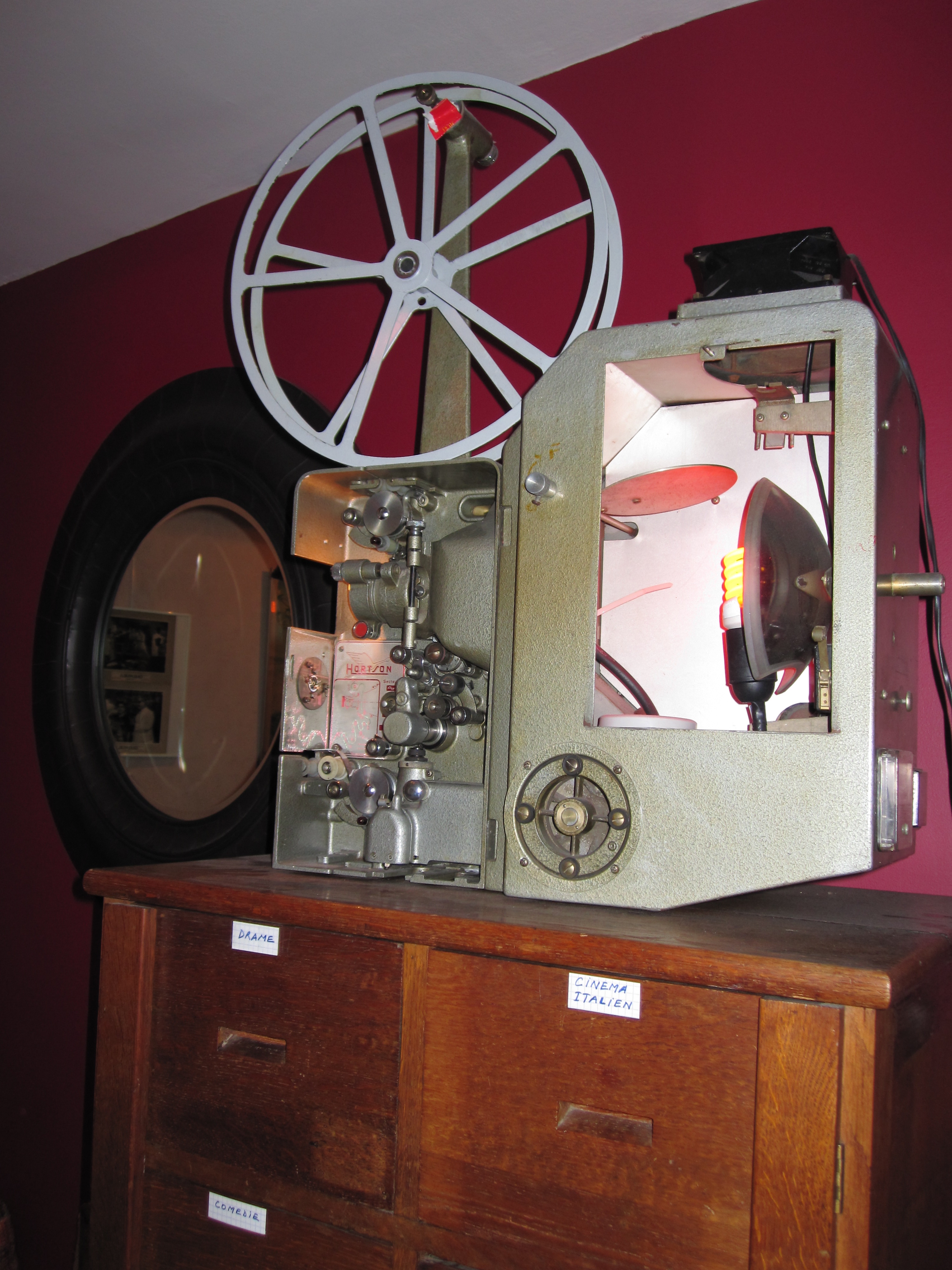
Finally, I’d like to give a Cinéclub shout-out to Le Nouveau Latina (20 Rue du Temple, 75004 Paris, Métro Hôtel de Ville) where we saw Rudo y Cursi last night. I’ve kind of abandoned the Cinéclub theatre review section of this blog, probably because there are only so many things you can really saw about a movie theatre (There are seats! And a screen! Sometimes they play movies you might want to see!). But in addition to the fact that it is literally next door to my apartment building, Le Nouveau Latina is really one of the more charming Cinéma d’Art et d’Essai in Paris. Specializing in Spanish, Portuguese, Latin American, and Italian films (though they also show a healthy dose of other classic and contemporary independent films from France and the US), Le Nouveau Latina reliably has a lot of great stuff showing on any day of the week on their two well-maintained screens. It’s also a darling place to hang out, with a large café and a well-edited selection of books and DVDs for sale. I’ve even heard that they sometimes give salsa lessons upstairs. I have a personal soft spot for this theatre, as it was the site of both my first date with M (we saw Antichrist together!), as well as a midnight screening of Alien that was one of my first “ah-ha” moments about B. He held my hand during the scary parts and seemed only mildly amused by my histrionics. As I’m widely acknowledged as the most annoying person in the world to see movies with, B’s seeming cool made me suspect that he might be a good person to keep going to movies with for a long time.
Dearest reader, I’ve missed you. I hope your autumn is shaping up splendidly.
I don’t do drugs, I am drugs: Montmartre and l’Espace Dalí

My only obligation as of late—and this is a testament to how low-key my life has been recently—is to make sure that my dear M’s plants don’t die while she is gallivanting around the United States like a regular jetsetter. I normally don’t take such obligations very seriously (“They were alive the last time I was here!”), but she was such an attentive nursemaid to my little window box herb garden when I was island-hopping on the Mediterranean that I feel kind of guilty. So I’ve been making regular trips up to Montmartre, where she lives on the more residential side of Butte Montmartre. You know, the mountain with Sacre Coeur at the top? Perhaps you remember this little gem from a much earlier entry:
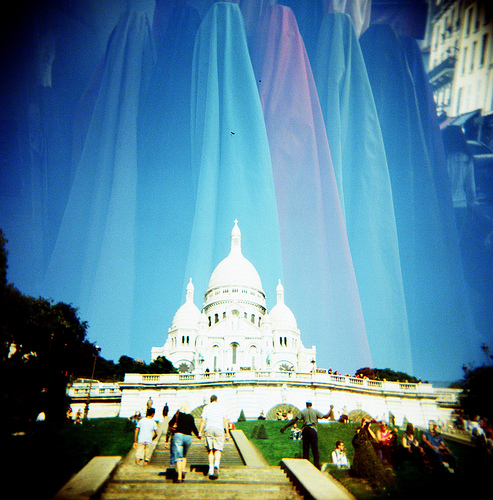
Anyway, I don’t love the hoards of tourists that frequent Montmartre, recreating scenes from Amélie and taking in overpriced burlesque shows at the Moulin Rouge. But the views of Paris from up high can’t be beat. I also really enjoy a stroll around the neighborhood that surrounds the Abbesses métro, especially if it involves ducking into the Librairie des Abbesses (30 rue Yvonne Le Tac, 75018 Paris), a smart and well-stocked bookshop with a drool-worthy selection of novels and poetry from small presses, books on psychoanalysis, and cookbooks. I know that list isn’t everybody’s bag, but man that bookshop gives me butterflies whenever I step out of the métro at Abbesses.
Frequent trips to Montmartre also increase the likelihood that I’ll be making an ill-advised stop at A.P.C. Surplus (20 rue Andre del Sarte, 75018 Paris), the outlet store of the iconic French brand with markedly lower prices than the main stores (and an accordingly odd selection of sizes). Barring such retail indulgence, a trip to M’s will usually involve a stop by Au Relais (48 rue Lamarck, 75018 Paris), a 106-year old café and restaurant that serves solid takes on classic French bistro food. The food isn’t particularly remarkable, but the staff is always friendly, and Au Relais’s location on the corner of rue Lamarck and the San Francisco-evoking Mont Cenis is a lovely break from the tourist circuit just a few blocks up the hill. Their cheeseburger is delish and their crisp yet pillowy fries can’t be beat.
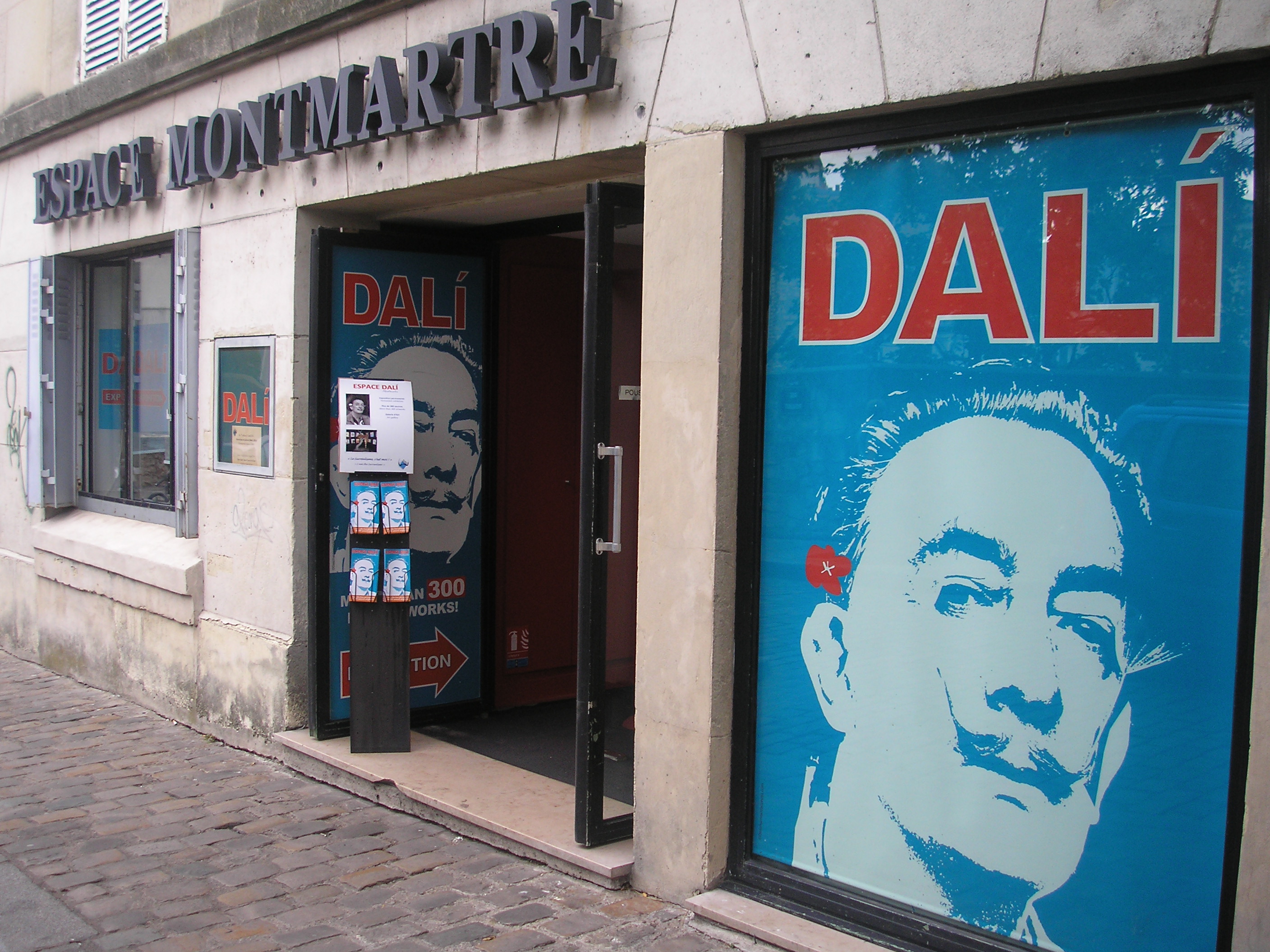
B and I have been on a quest to visit some of the smaller museums in Paris, and decided that watering day would be a good excuse to visit l’Espace Dalí (11 rue Poulbot, 75018 Paris, Métro Abbesses or Anvers), a small museum just a stone’s throw from Sacre Coeur that houses a permanent collection devoted entirely to Dalí’s work. Here we arrive at another installment of “another museum you might not be visiting on your trip to Paris.”

First of all, this is not St. Petersburg, Florida, and l’Espace Dalí houses mostly minor works in bronze and glass as well as a handsome collection of lithographs, engravings, and other original works on paper. The visitor is quickly made aware of what a hustler Dalí was in his lifetime, often producing or commissioning large numbered editions of each individual work, some of which seem rather rushed or glib. The space itself is rather funky and could use a serious paint job. I’d been wondering who buys all those stick-on mirrors at Ikea, but now I know. The kitsch factor is high. The museum includes a gallery with works for sale (mostly poorly-executed limited edition prints of Dalí major paintings), a gift shop with an assortment of Dalí perfumes and knick-knacks, a plaster trompe l’oeil reproduction of the medieval church that used to be on the site, and a delightful Dalí photobooth that allows you to insert your head into works from the museum or mustachioed portraits of the master himself. There is also a small collection of Dalí’s furniture and home furnishing designs, including the iconic couch modeled on Mae West’s voluptuous lips and a swoon-inducing set of exquisite silverware.

Okay, so it’s funky and filled with minor works. Why bother? Well, if you’re a literature buff, you’re going to love looking at the many works on paper that Dalí produced in response to or to accompany classic texts, including the Old and New Testament, The Quest for the Grail, Alice in Wonderland, Tristan and Isolde, Ovid’s Art of Love, Romeo and Juliet, Rabelais’ Gargantua and Pantagruel, and Freud’s Moses and Monotheism.

There is also a terrific selection of original photomontages that Dalí created for his tarot series (real enthusiasts can purchase a working Dalí tarot set in the giftshop for 79€). I particularly enjoyed the 1971 gouache series entitled “Memories of Surrealism,” a wonderful mishmash of textbook art history images and the surrealist imagery that Dalí made the stuff of many college dorm rooms.
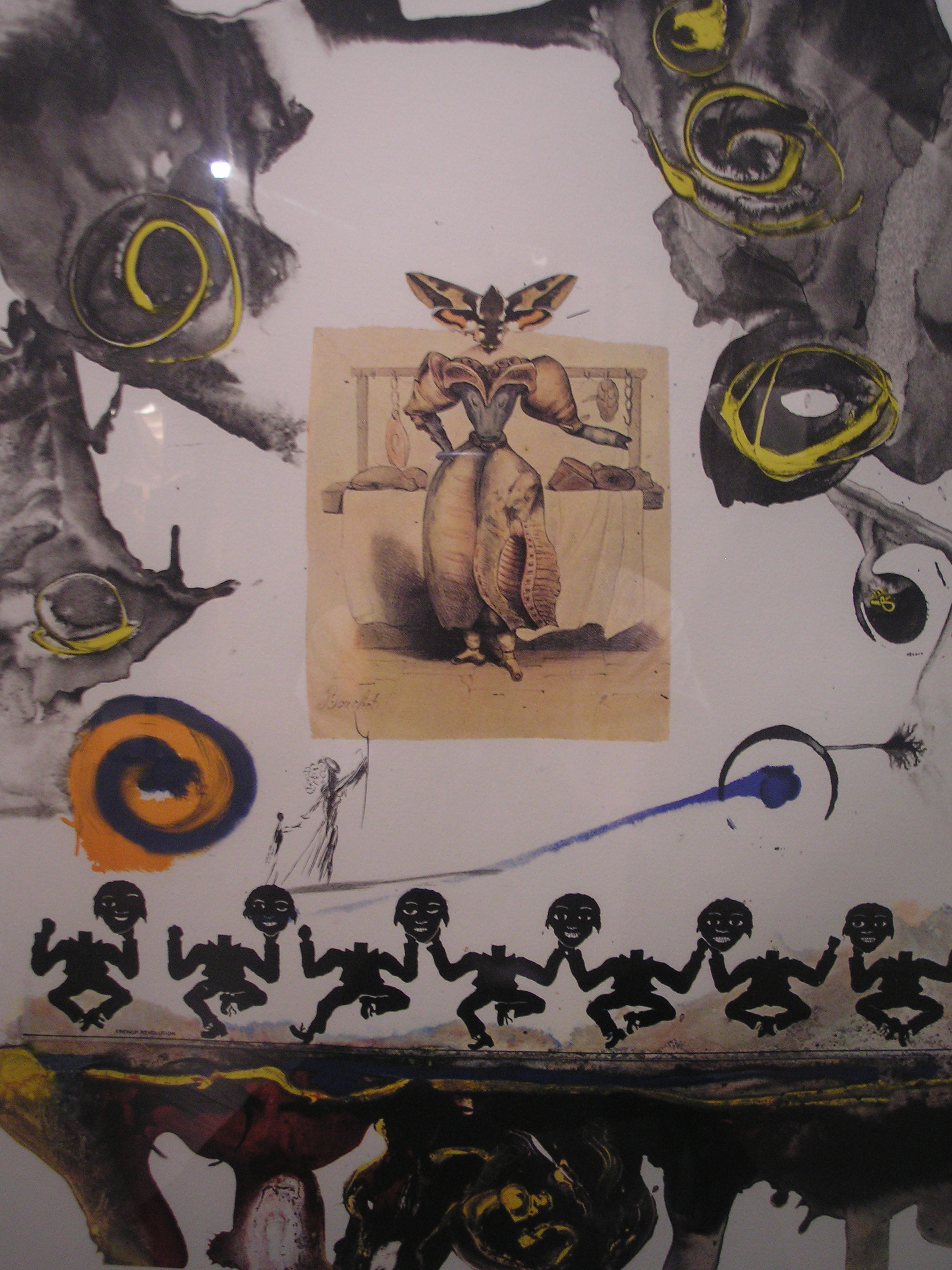
I’ve been reluctant to like Dalí in recent years, probably because his work has become the stuff of pop culture cliché. But his deep interest in allegorical texts and his nuanced reading of Freud were news to me, and I found the many works on paper at l’Espace Dalí to be serious and fascinating.

It won’t be everyone’s cup of tea, and if you’re after the popular oil paintings that everyone knows and loves, your time and money would be best spent on plane fare to Florida. But if you’re in Paris and looking for a different angle on the artist (and have a high threshold for kitsch), l’Espace Dalí might be worth a visit.
 Oh, and the photobooth is lots of fun, especially if you’ve always had mustache-envy like yours truly.
Taco Mardi!
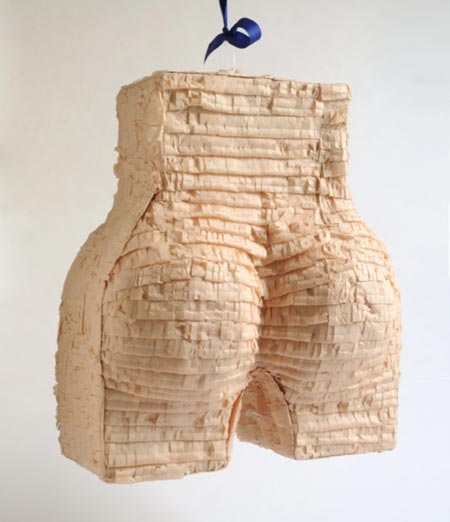 If I were making a list of things I miss about the United States, Mexican food would be numbers one, two, and three. I know it sounds kinda hysterical, but I really can’t tell you how much of a shift in my diet I had to make coming to live in Paris. I know, cry me a river made entirely of Camembert and Roquefort, right? But seriously, I miss Mexican food in a nearly elemental way. When my mother was pregnant with me, she constantly craved green chile smothered burritos, a decision that left her with a happy fetus and a lot of heartburn. We joke that I’ve loved New Mexican food since I was in utero and we usually make it down to Taos, Santa Fe, and Albuquerque at least once a year for a serious chile fix. Let’s just say Clarence in New Mexico would make Clarence in Paris have an aneurism. The rule of these vacations is that we eat chile at every meal until our gastrointestinal systems mutiny. Barring a trip to New Mexico—or a couple of coolers filled with chiles from Hatch Chile Days and a couple of bags dried red chile pods from the now (sob) extinct Chimayo ranch—my hometown of Denver has some nice stopgap options for excellent New Mexican style food. I’m planning a whole Clarence in Denver feature when I go home at Christmas for the first time in a year and a half. That is, of course, if I’m not too busy warding off culture shock and binge shopping at Target.
I had to acclimate to Southern California style Mexican food when I moved to Orange County in 2005. I’m sure that it is much more authentically Mexican than the “Mexican” I’m really nuts for, which isn’t TexMex either. There are more big square states out West than most people are aware of, and the kind of food I like best is in New Mexico (with nods of recognition to Colorado and Arizona). Anyway, one thing I did really get to like in California is the ubiquity of taco stands and trucks. There aren’t very many taco trucks in the soulless part of Orange County that I inhabited (though the one that hangs out in front of the Santa Ana courthouse on weekdays is killer and sure takes the edge off of traffic school). There are, however, a lot of prime brick and mortar locations for my very favorite alliterated holiday: Taco Tuesday. Mix bargain tacos with drink specials that encourage getting blitzed before midweek and you’ve got yourself a routine. My best friend N and I made a near-religious habit of Taco Tuesdays in the past few years.
Should you find yourself in Orange County on that oh-so-wonderful day of the week, you should definitely check out the bargain eating and boozing options. In Costa Mesa, you can hit Taco Mesa (647 West 19th Street, Costa Mesa, CA 92627), where they have a particularly diverse selection of yummy and healthy tacos, a serve-yourself salsa bar with killer escabeche and salsa verde, and dollar cans of Tecate. Their heated outdoor patio overlooks the parking lot of the DMV, so you can revel in your culinary indulgence while watching your fellow citizens’ brains explode with frustration. Maybe you can invite a DMV-disgruntled stranger over to your table! At a mere two bucks for a taco and a beer, everybody can afford to be generous! Make sure you splurge an extra buck and get yourself a blackened chicken taco. You won’t regret it.
Should you find yourself coast-side in Laguna Beach, treat yourself to a few fish tacos at Taco Loco (640 California 1, Laguna Beach, CA 92651). If you can get over the tacky tourists, the screeching traffic on Highway 1, and the kind of annoying teenagers that spawned an entire generation of reality television shows, Taco Loco has some of the lushest fish tacos in the area. Served with little more than a chucky avocado salsa, the blackened fish, swordfish, shrimp, and calamari can’t be beat. Skip the chicken and beef variations, and splurge on the seasonal lobster taco when it’s on the menu. The prices are steeper, but it will still be the cheapest thing you’ll eat in Laguna.
Finally, if your main goal is to just tie one on and eat some tacos in the process, I can’t recommend enough the John Wayne airport-adjacent El Torito (951 Newport Center Drive, Newport Beach, CA 92660). Taco Tuesday is a real institution at this rather tragic locale, where Irvine corporate worker drones and tired business travelers converge every Tuesday for dollar tacos and enormous bargain margaritas and beers. It’s got everything you want in an Orange County Taco Tuesday: an assembly line of skillful chefs who make the tortillas to your order, a light rock soundtrack, a hearty helping of bad plastic surgery, a parking lot full of BMWs, and the stench of quiet desperation. Swear to God, N and I were once debating if we should call a cab outside of El Torito and a strange woman asked us if we wanted to use the breathalyzer that she had recently picked up at Costco. The more you know, I guess? Anyway, it’s a real train wreck of a place and I miss spending my Tuesday nights there.
Every Tuesday since moving to Paris, I forlornly remember that somewhere in the world people are eating bargain tacos and getting sloppy. Since such an item isn’t on the agenda here in France (c’mon Chipotle! You could make a fortune on the drunk study abroad kids alone!), I woke up today with a clear sense of purpose: fish tacos and beer for dinner, dammit.
This was no small proposition. While there is a “Mexican” foods section at most large Monoprix in Paris, the offerings are horrifying. Most stores will sell something they call “Mexican style chili powder,” usually with ginger and paprika as the first two items on the ingredient list (huh?). It’s virtually impossible to find fresh hot chiles at the many vegetable markets in Paris, and I’ve found it’s difficult to use Thai and Vietnamese chiles you can buy in the Asian markets here in comparable proportions to my beloved jalapeños, serranos, and poblanos. I have discovered that you can buy some decent dried chiles and corn flour at L’Epicerie de Bruno (30 rue Tiquetonne, 75002 Paris) and Izrael (30 Rue François Miron, 75004 Paris), and I make a habit of requesting black beans, cans of roasted green chiles, and pickled jalapeños whenever anyone comes to visit from the States.
After some brutal run-ins with French packaged tortillas, I threw in the towel and gave up. Fortunately, among the many other skills he possesses, B is an avid home tortilla maker. I was skeptical at first, but now I can’t believe I haven’t been making tortillas from scratch my whole life. They are easy, stupidly cheap, and much more delicious than their shelf-stable brethren. The proportions are simple: roughly 2 parts masa to 1 part warm water. In a bowl, combine your masa with a couple pinches of salt. Then, slowly add the warm water, integrating it as you go along until you have a firm dough. You may need more or less water, obviously.

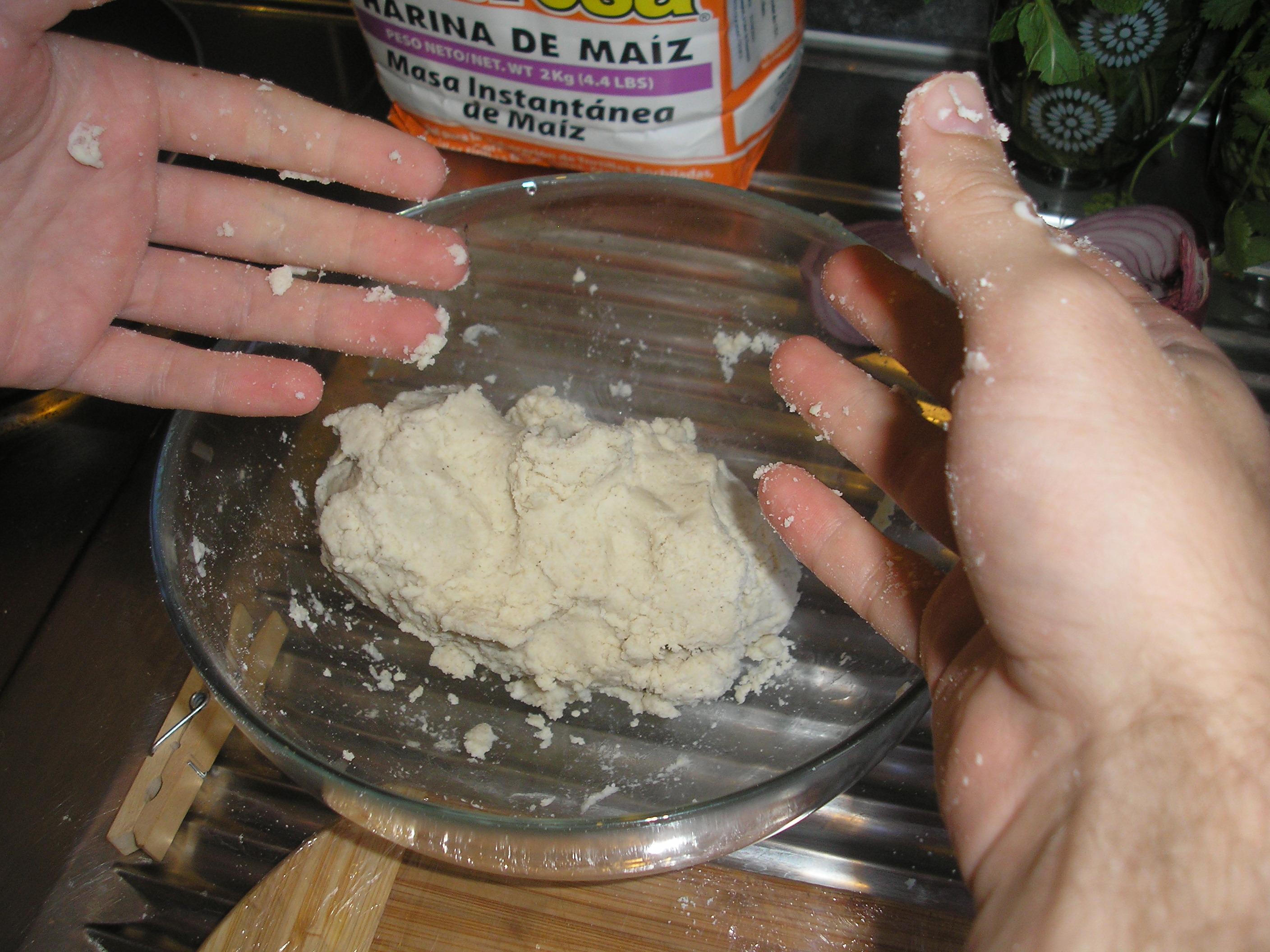
Then roll the dough into little balls, and smoosh them between two nonstick surfaces. We have fashioned a tortilla press out of a wooden cutting board wrapped in cling wrap and the back of a frying pan. If you find your tortillas are sticking to the pressing surface, dust it with a bit of dry masa.
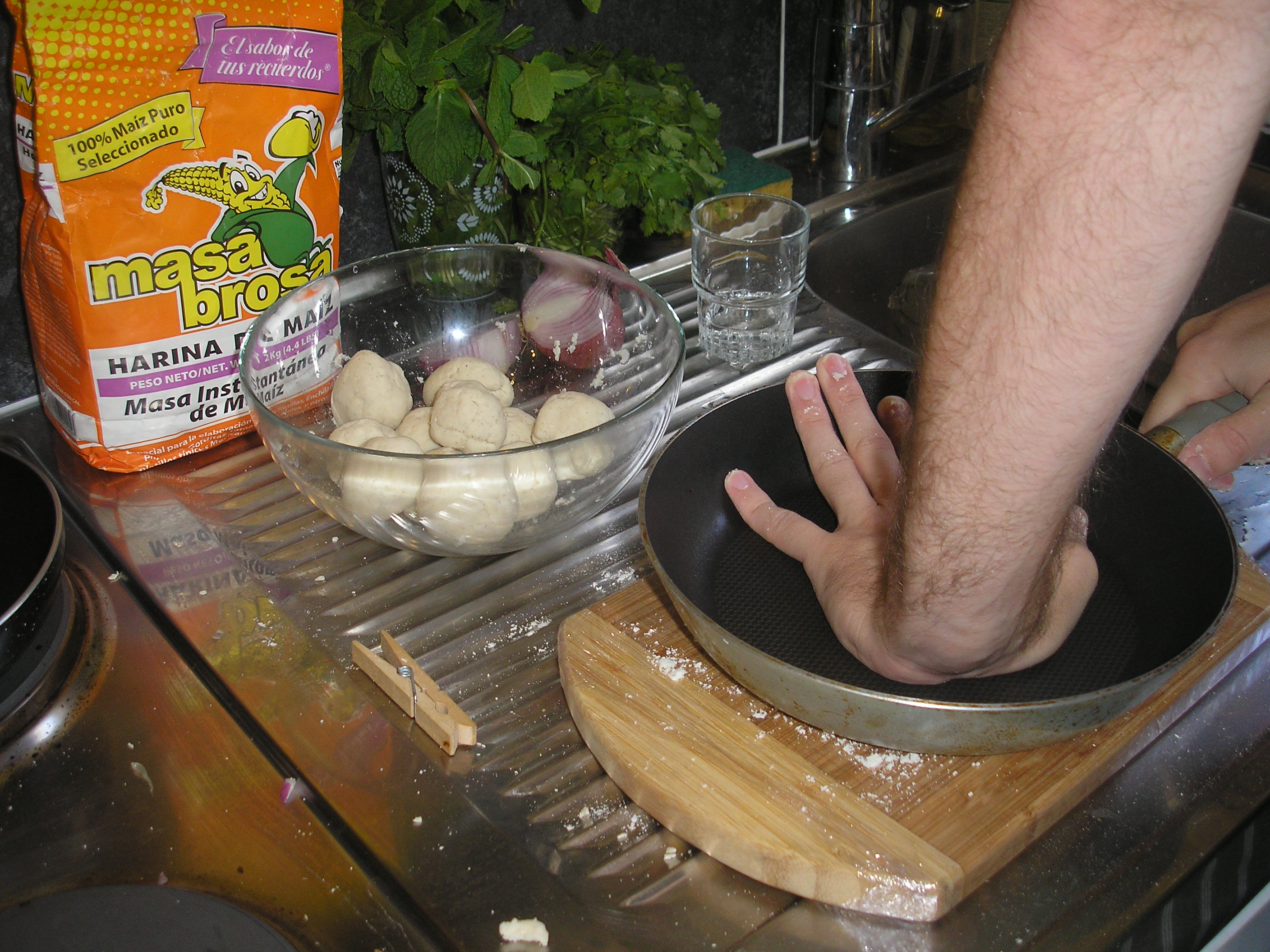
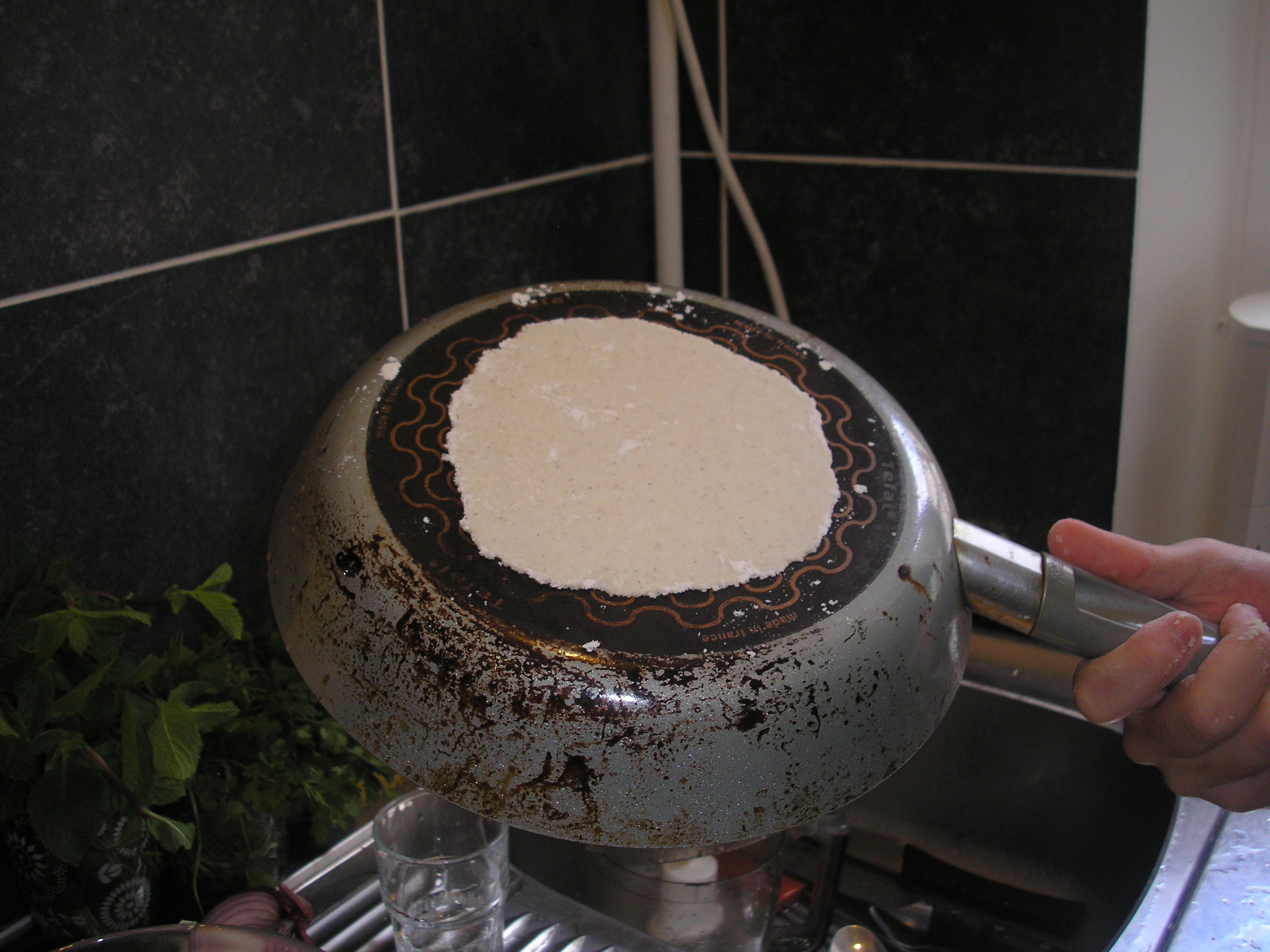
Heat up a nonstick pan until it’s super-smoking hot. Then drop your tortilla onto the dry surface and cook about 10-15 seconds on each side. It should be easy to flip them without using a spatula, as nothing should be remotely sticky. This is ideally a two-person operation. B and I had a rather nice rhythm going tonight where he pressed and I cooked and flipped. Stack your tortillas in a teatowel, rewrapping your little bundle after each addition to keep them warm.
While these buggers could obviously be the delivery device for a million different things, tonight we ate:
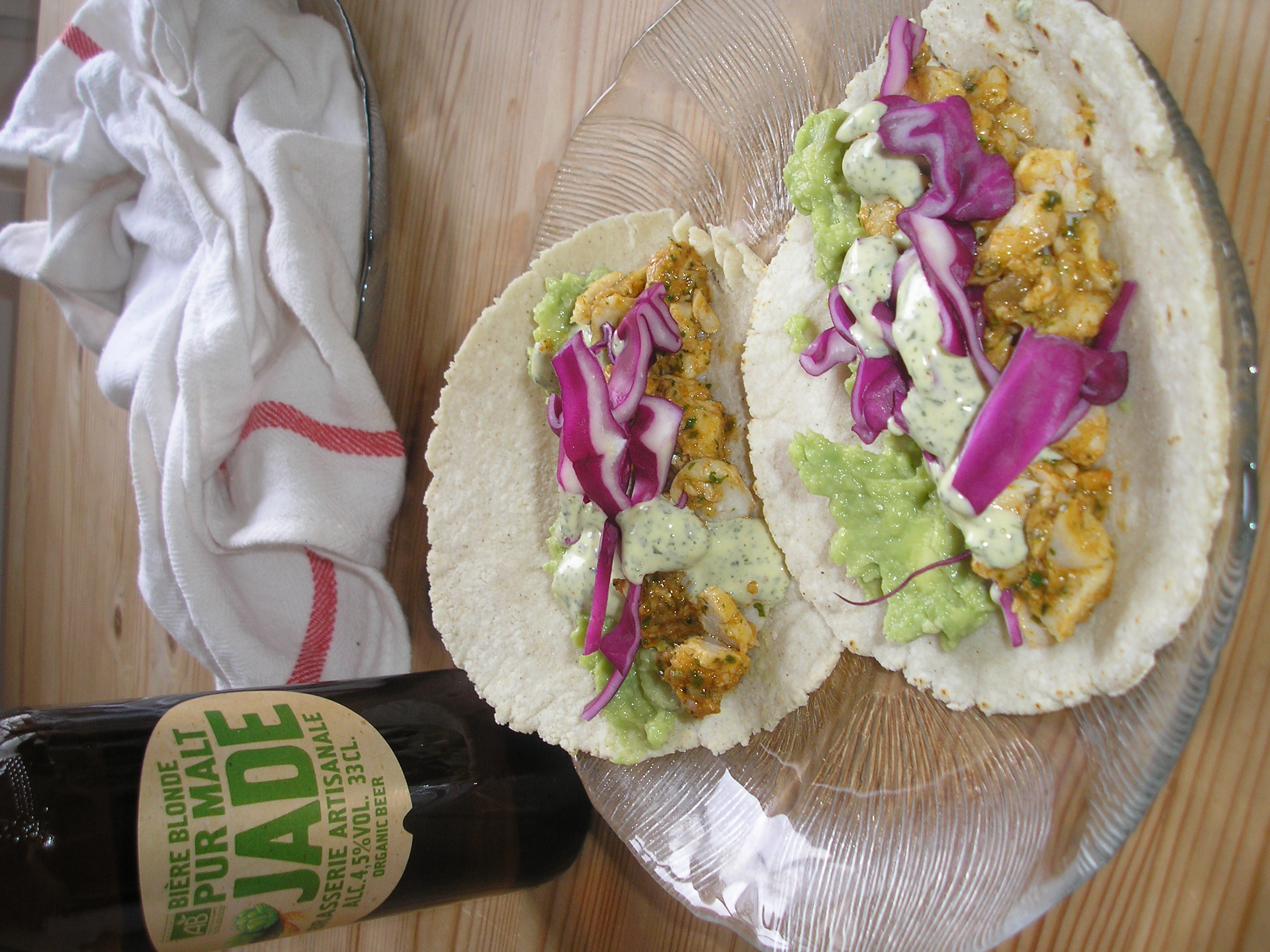
T’s “Take That France!” Tuesday Tacos
For the fish:
1 pound cod filets, skinned and cut into 1-2 inch pieces (sole, halibut, mahi-mahi, swordfish would all do the trick)
¼ red onion
1-2 large garlic cloves
1 teaspoon cumin powder
1 large handful of fresh cilantro (stems are not a big deal here)
1 tablespoon of the hottest chili powder you can find (I used my dwindling supply of Chimayo red chile)
A couple of shakes from a rather old bottle of Tapatio abandoned by a fellow expat (untraditional in a marinade, but surprisingly delightful)
2 tablespoons olive oil
the juice of ½ of a lime
Combine everything except the fish in your food processor and pulse until smooth. Salt and pepper to taste, then cover your fish with the marinade.
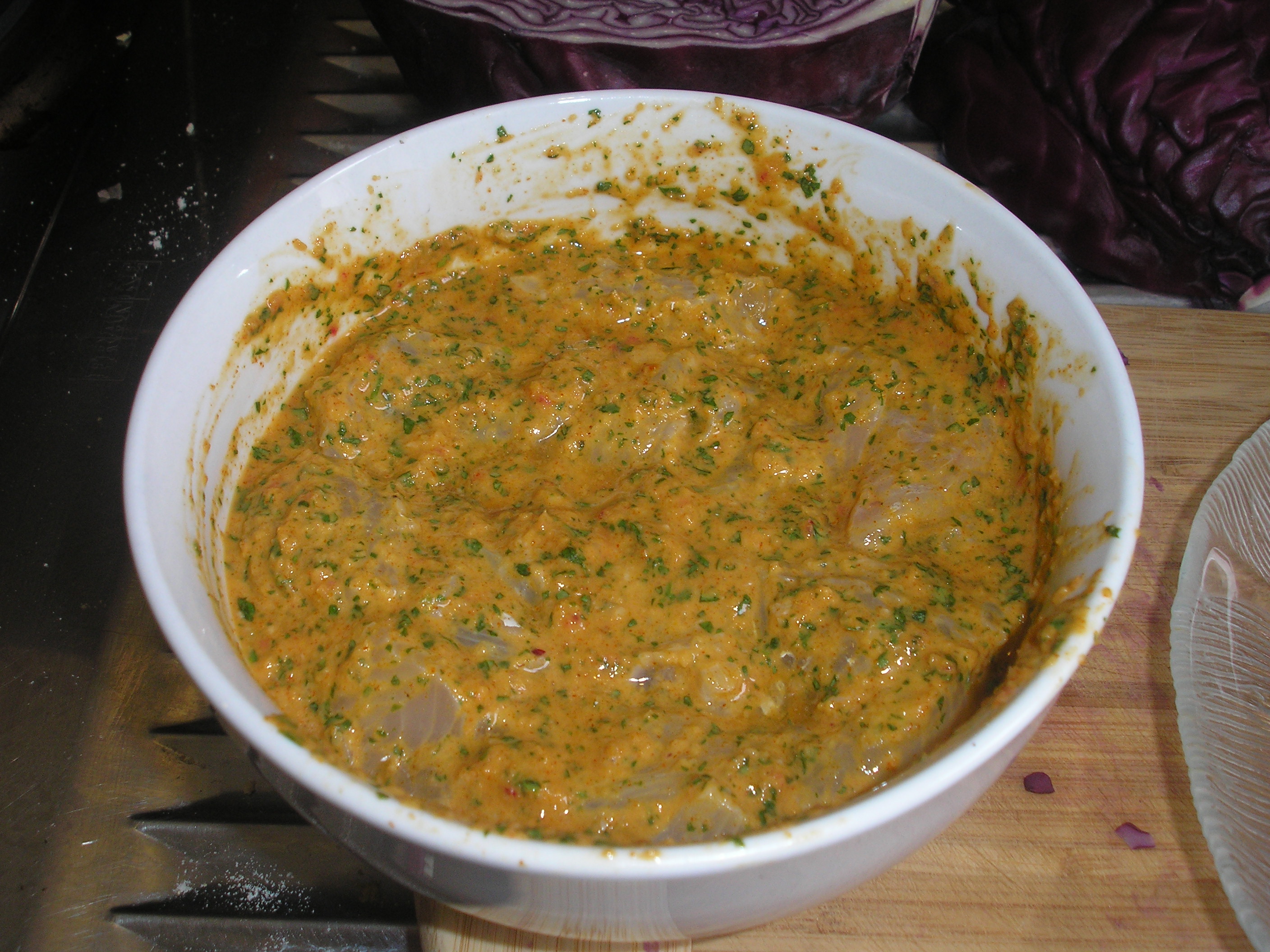
While this is marinating, you can make my ode to the Yucatan: green mayo. This my attempt at a Parisian homage to the ineffable combination of mayonnaise and habenero salsa that you find in plastic squeeze bottles at every taco stand in the Yucatan. Obviously, if you have access to proper habenero salsa, you can skip this step (though my extemporaneous sauce was pretty fantastic).
Combine the following in your food processor:
4 tablespoons Maille or homemade mayonnaise (mayo snob!)
1 large handful of fresh cilantro leaves
1 large handful of fresh mint leaves
juice of ½ of a lime
1 teaspoon of dried cumin
a couple of shakes of cayenne pepper
salt and pepper to taste
Pulse until smooth, and refrigerate until serving.
Fry up your marinated fish in a hot skillet, cooking just until flaky. My cod was really delicate and fell apart, but who cares when it’s in a taco? I served the warm corn tortillas and fish with homemade guacamole, strips of purple cabbage, and a drizzle of my green mayo. It might just be that I haven’t eaten fish tacos in over a year, but holy shit these tasted good. The spiciness of the fish against the creamy avocado and minty mayo with a bit of crunchy cabbage in a fresh warm tortilla – I wish I ate like this everyday. We cracked open two bottles of the one decent French beer we’ve found and dug in, quickly annihilating twelve tacos between us. Sated and blissed out, B declared “It’s a good day to be me!” which I took as a highest-order compliment of my fish taco skillz. Obviously this would be a bit labor-intensive if you are in a place where you can just go out for dollar tacos on Tuesday, but it’s a nice stopgap measure if you find yourself in taco-free Paris (read that last part so it rhymes, okay?).

Clarence Trolls J-Date: Getting Your Deli Fix in Paris
 B has been working hard on learning Hebrew the past few weeks with the eventual goal of reading the Old Testament. I’ve been working less hard, spending my time buying books that relate to my dissertation and putting them in stacks, working on my origami, and marveling at B’s capacity for filling notebooks with lists of words and conjugations for hours on end. I spent the last few lazy afternoons reading Mary McCarthy’s The Group, which my mother loved when it first came out in the 60s and I’ve been meaning to read for ages. It was pretty great, though it made me thank my lucky stars that I wasn’t born in a different generation. As I have a penchant for loving jerks in literature, my favorite character was Norine Schmittlapp, the nemesis of “the group” and the closest thing to a real radical that McCarthy’s 1930s New York has to offer us. Even so, her portrait is terribly bleak, if surprisingly funny. After her first marriage fails, she marries a wealthy Jewish banker whose family has changed their name from Rosenberg to Rogers, a fact that she shares with “a particular kind of relish” with her aghast acquaintance Priss.
In fact, Priss’s chance encounter with Norine near the end of the novel was one of the best and sharpest parts of the book. Priss meets Norine in the park, where Norine is pushing her infant son Ichabod (“‘Aren’t you afraid he’ll be called ‘Icky’ in school?’ she asked impulsively. ‘He’ll have to learn to fight his battles early,’ philosophized Norine. ‘Ichabod the Inglorious. That’s what it means in Hebrew. No glory.’”) around naked in his expensive stroller. Norine casually pats her son’s penis, a practice that scandalizes Priss, who is terrified of arousing her own toddler son and would almost rather “he be dirty than have him get an Oedipus complex from her handing him.” Norine insists that Priss come over to her lavishly furnished but disheveled home that nevertheless the site of a well-regarded bohemian salon. There, Norine recounts to Priss her affair with another woman’s husband and is brashly matter-of-fact about her sexual proclivities and experiences. When Priss attempts to describe her (or more accurately, her husband’s) behaviorist theories of child-rearing, Norine condescends the poor woman. “‘You still believe in progress,’ she said kindly. ‘I’d forgotten there were people who did. It’s your substitute for religion. Your tribal totem is the yardstick. But we’ve transcended all that. No first-rate mind can accept the concept of progress any more.’” When Priss accuses Norine of having abandoned her political radicalism, Norine declares that she leaves politics to her husband Freddy:
“Being a Jew and upper crust, he’s profoundly torn between interventionism abroad and laissez faire at home. Freddy isn’t an intellectual. But before we were married, we had an understanding that he should read Kafka and Joyce and Toynbee and the cultural anthropologists. Some of the basic books. So that semantically we can have the same referents.”
According to Norine, Freddy tolerates this curriculum requirement because
“Freddy’s philopregentitive; he’s interested in founding a dynasty. So long as I can breed, I’m a sacred cow to him. Bed’s very important to Freddy; he’s a sensualist, like Solomon. Collects erotica. He worships me because I’m a goy. Besides, like so many rich Jews, he’s a snob. He like to have interesting people in the house, and I can give him that.”
In her own self-diagnosis, Norine’s only real problem is “her brains”:
“[I was] formed as an intellectual…Freddy doesn’t mind that I can think rings around him, he likes it. But I’m conscious of the yawning abyss. And he expects me to be a Hausfrau at the same time. A hostess, he calls it. I’ve got to dress well and set a good table. He think it ought to be easy because we have servants. But I can’t handle servants. It’s a relic, I guess, of my political period. Freddy’s taken to hiring them himself, but I demoralize them, he says, as soon as they start in the house. They take a cue from my cerebralism. They start drinking and padding the bills and forgetting to polish the silver. […] I’ve been trying to turn over a new leaf, now that we have a new house. I start out with a woman who comes to massage me and give me exercises to relax. But before I know it, I’m discussing the Monophysites or the Athanasian Creed or Maimonides. The weirdest types come to work for me; I seem to magnetize them. The butler we have now is an Anthroposophist. Last night he started doing eurhythmics.”
When Priss asks if Norine really regrets the Vassar education the women shared, Norine declares “ ‘Oh completely…I’ve been crippled for life.’”

Of course it’s obvious to both Priss and the reader that Norine’s real problem is not her cerebralism but her narcissism and anti-Semitism, which become apparent when calls her own husband a “Yip” and asks Priss with more than a touch of anxiety if she thinks that “Ichabod looks Jewish.” Norine is the great satirical monster of the text, a totally unsympathetic character that is an ingenious cipher for the other women’s anxieties, be they about housekeeping, sexual prowess, education, or parenting. But in her own right, she is such a riveting mess, with the neck-rings on her blouses and her dirty polar bear skin rug; her theories about underlying lesbian drives, oral gratification and penis-envy that are coupled with her brassy declaration that “Freud is out of date”; and her ad hoc parenting cues taken from anthropological texts about the Pueblo Indians. She wears little Ichabod in proto-Baby Björn to a funeral and declares that it serves the same function as a papoose, allowing her to give Ichabod the experience of death early, rather like the mumps. She serves enormous wedges of chocolate cake to the children for lunch. I rather loved her.
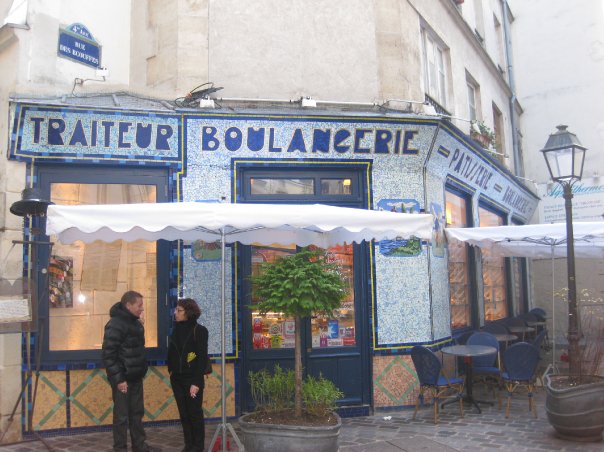
Anyway, I don’t know if it’s my boyfriend’s newest obsession with acquiring Hebrew or reading about old-school New York and the dangerous shiksa Norine for the past few days, but I’ve been longing for some serious kosher deli food. I usually get my fix in Paris with a quick trip to Florence Kahn (24 rue des Ecouffes at the corner of 19 rue des Rosiers, 75004 Paris, Métro St. Paul), a fabulous Jewish traiteur in the Marais with one of the best tile mosaic storefronts you’ll ever see.

Inside, you’ll find an amazing selection of fresh bread and pastries, pickled herring and other smoked fishes, blinis, pickles, goulash, latkes, and pierogis, as well as house-cured and smoked pastrami, corned beef, and tongue. My go-to choice:

The Big Pletzel Sandwich. That’s really what it’s called, meaning ordering it always feels kind of silly: “Je voudrais un Big Pletzel Sandwich, si’l vous plaît.” For about seven euros, you get an enormous fresh bun filled with layers of homemade pastrami, pickles, roasted red peppers, fresh tomatoes, and some kind of unidentified special sauce. You can get it warmed up and take it to go, or you can sit in their lovely outdoor seating and watch the rue de Rosier hoards line up at L’As du Falafel. Florence Kahn is a great alternative to falafel if the lines at L’As are daunting or if you want a real carnivore fix. It’s also a lovely place to buy the fixings for a picnic or an easy dinner, like this one I made earlier this week:

I bought the blinis and the glorious lox at Florence Kahn. I gave the blinis a quick shake in some melted butter in a pan, and added some crème fraîche, capers, and red onion that I had in my fridge. Much fancier and more delicious than it had any right to be, especially given how easy it was to prepare.
The one thing I hesitate to buy and reheat, however, are latkes. Somehow preprepared or frozen ones are never quite right, even if you fry them in oil. Ever since I saw a soggy tray of them at Florence Kahn, I’ve had proper latkes on the brain. Today I pushed up my sleeves and got to work. I’d never made them before, so I got some ideas from Epicurious and the food section of the New York Times online. I settled on this compromise recipe (based on what I had on hand):
9 all-purpose white potatoes, peeled, grated, and drained
½ of a white onion, grated
1 shallot, grated
3 eggs, beaten
¾ cup of baguette breadcrumbs (you’re supposed to use matzo meal, but all the kosher stores are on vacation, just like the rest of Paris in August)
Salt and pepper
Canola oil for frying (I used extra virgin olive oil, because my kitchen is too small for ingredients I rarely use)
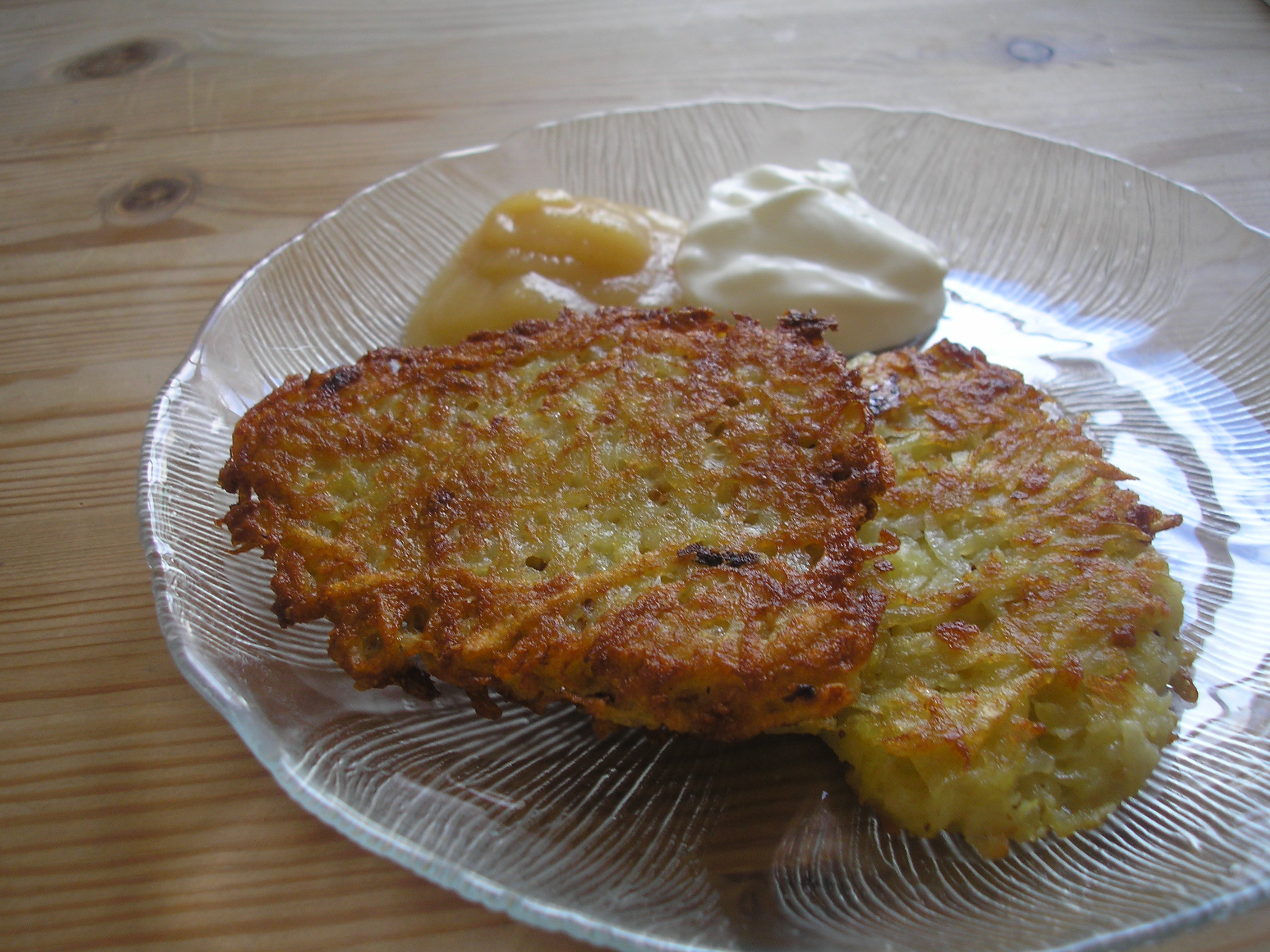
Applesauce and sour cream for serving (crème fraîche if you’re on this side of the pond)
After peeling and grating for what seems like forever, incorporate your potatoes, onion, shallot, and eggs together. Then, add breadcrumbs (or matzo meal) gradually to soak up the excess liquid. Salt and pepper to taste.

Heat up about two tablespoons of oil in a deep frying skillet. When crackly, add a heaping tablespoon of the batter to the oil, patting it down with the back of your spoon to form a thick pancake. Fry each side 2-3 minutes or until golden brown and lacy at the edges. I was able to fit three latkes in each batch, and each batch took approximately one Róisín Murphy jam to cook. I incurred only two minor splatter burns in the whole process (the cost of doing business if you ask me). I may or may not have been pretending to be Polly, the most sympathetic member of The Group, who cooked grandiose meals every night for her publisher lover (scandalous!) on her tiny hotplate.

Drain on papertowels.
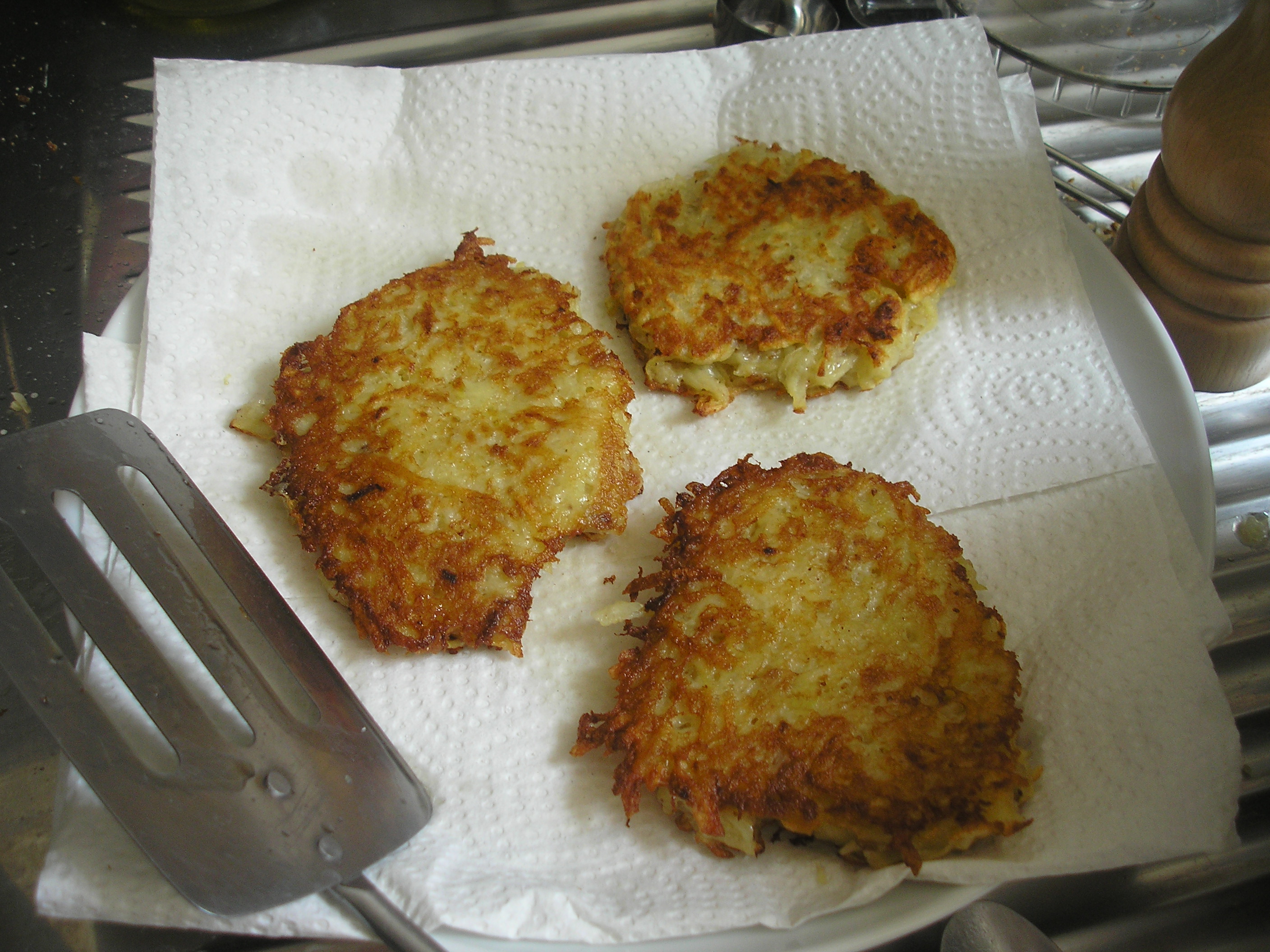
Keep the earlier batches warm, either in a low oven (aren’t you a fancypants!) or in a covered pan.

Serve with sour cream and applesauce, preferably to a bewildered student of Hebrew, who will likely seem very impressed at your labor-intensive weekday lunch.
Hungerdome! The Macaron Battle
The idea: Two men enter, one man leaves. Need a refresher course?
You remember now. Man, I miss Mel Gibson circa 1985.
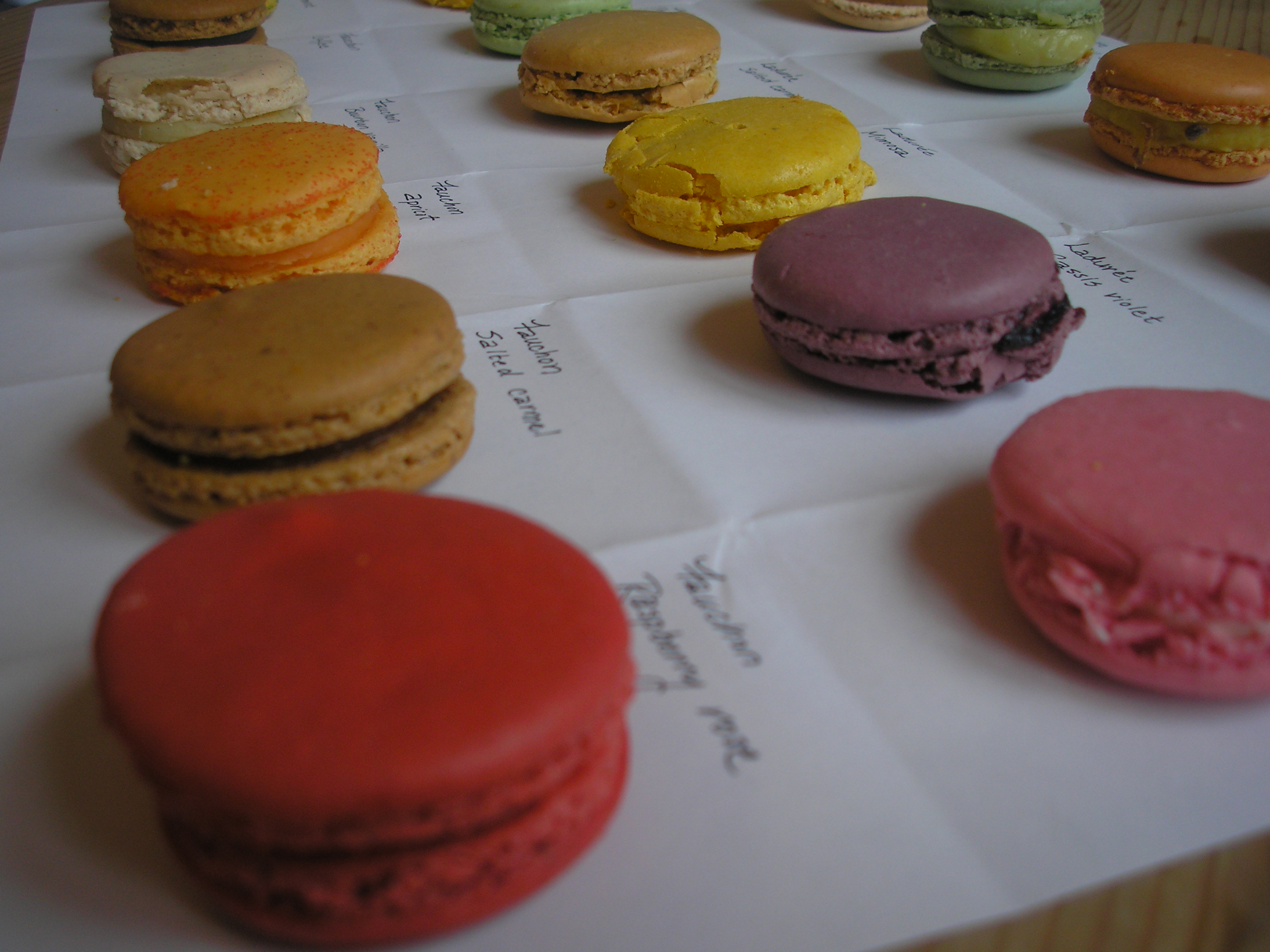
Today in the Hungerdome, three Parisian macaron stalwarts go head to head in a pseudo-scientific tasting battle.
The contenders:
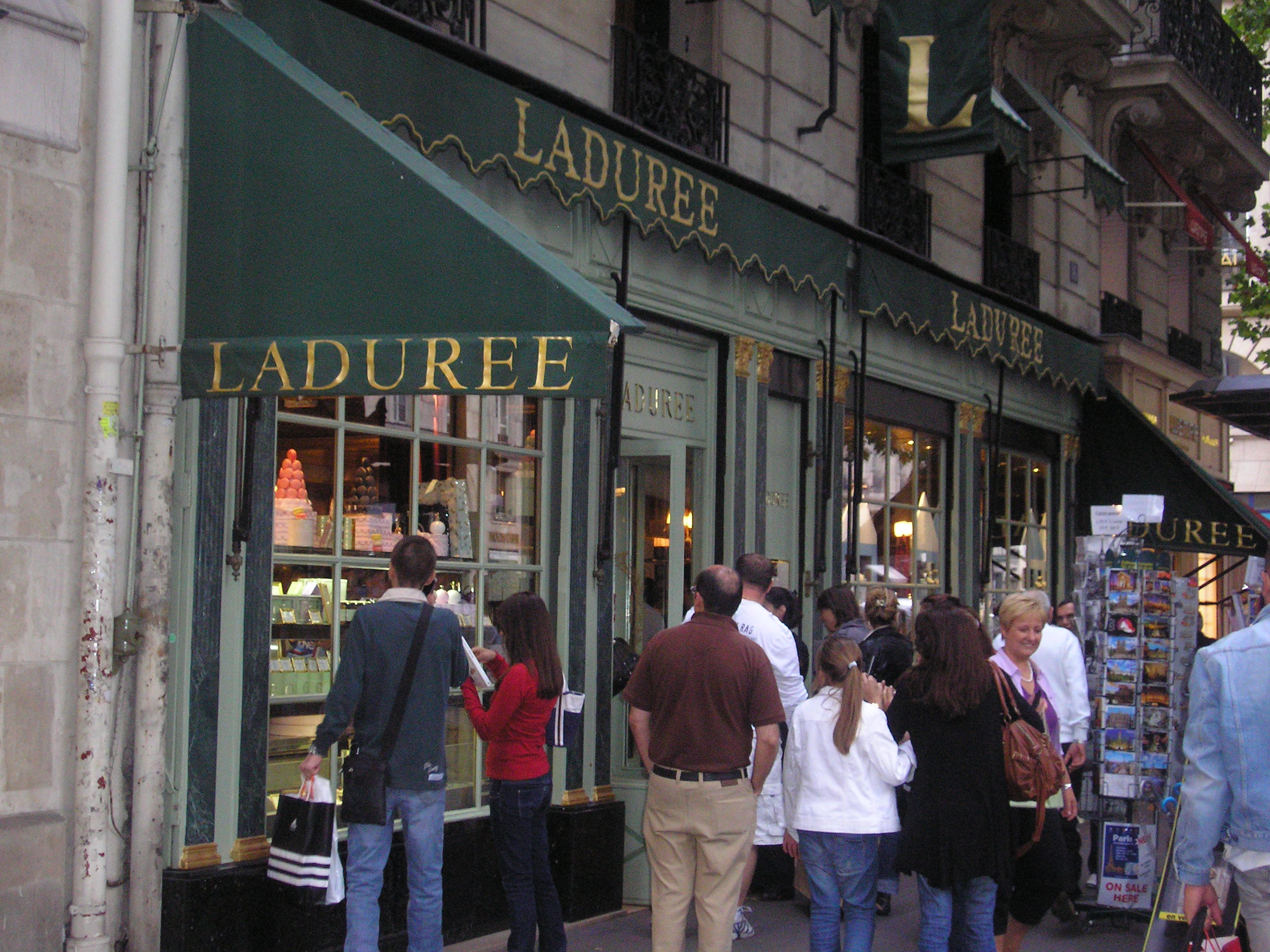
Ladurée (16 rue Royale, 75008 Paris, Métro Madeleine). Ostensibly the inventor of the double-decker macaron that we know and love, the Ladurée bakery first opened its doors in 1862 and is undoubtedly considered the purveyor of classic French macaron. With the largest selection of our competitors, Ladurée sprinkles in seasonal offerings (lily of the valley, Granny Smith apple, grapefruit rose) with the classic macaron battery of flavors (lemon, chocolate, vanilla, coffee, pistachio, and rose). Long lines cue outside of the various pastel-signed Ladurée locations for cookies, chocolates, and massively overpriced brunches. Most guidebooks would call Ladurée a must-do Parisian experience. The décor is totally over-the-top, with baroque brocades and gilded everything. The kinds of women I don’t particularly like make a point of eating here. Not for the claustrophobic or sociophobic. Definitely not for the overweight tourist phobic.
We chose: lemon citronella, pistachio, salted caramel, mimosa, cassis violet, and rose.
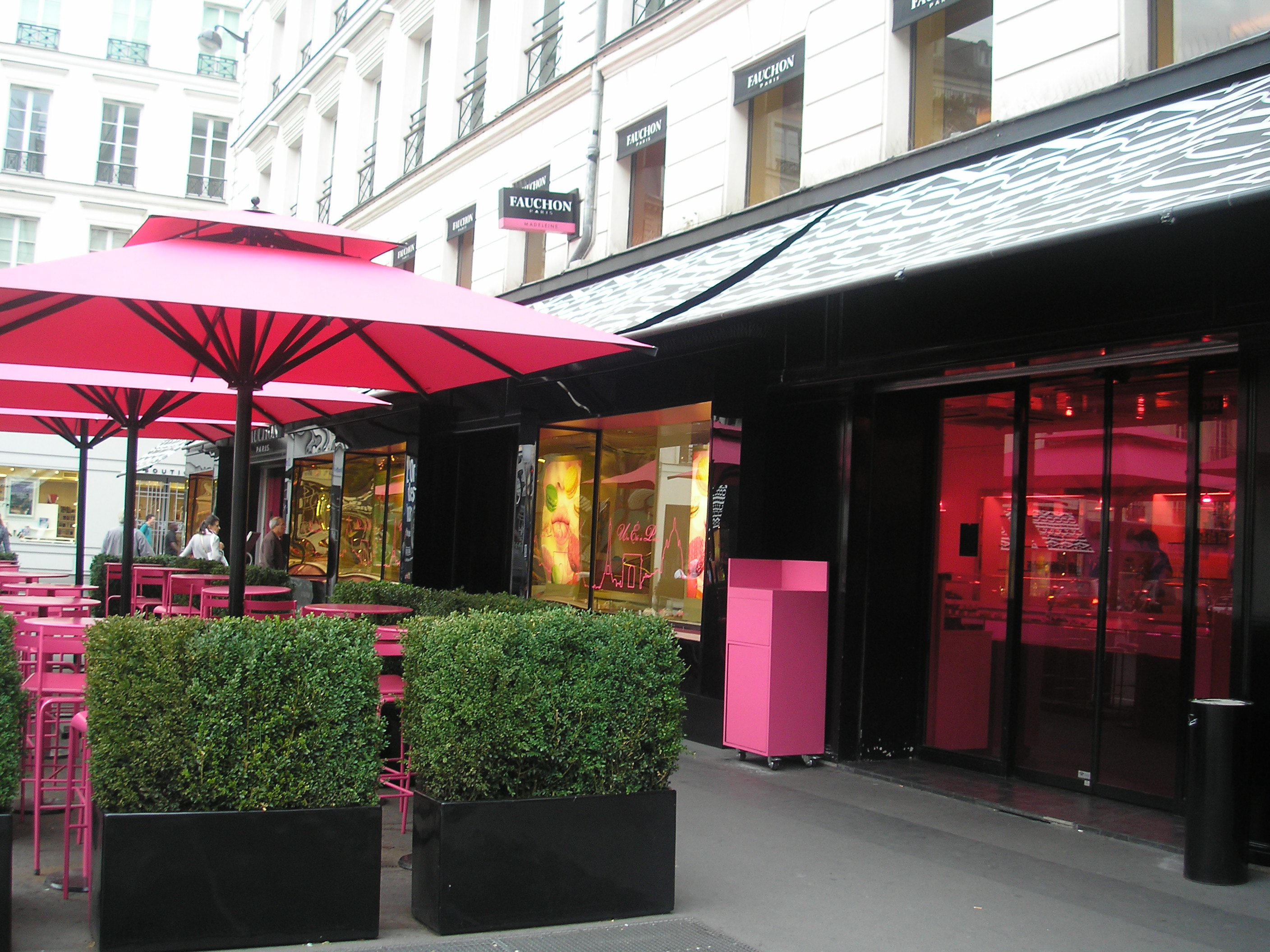
Fauchon (24-26 Place de la Madeleine, 75008 Paris, Métro Madeleine, though if you need to take public transportation, you probably can’t afford to shop at Fauchon). Operating in Paris since 1886, Fauchon is perhaps the most rarified of the fancy food markets in Paris, though for my money overpriced and overplayed (I would recommend real foodies go to La Grande Epicerie instead). The smallest selection of flavors of our competitors, Fauchon keeps their macaron selection tight and mostly classic (apricot and lemon mint were the most adventurous flavors available today). Fauchon is worth a gander if you enjoy looking at food that is too beautiful to eat or if you need a gift for that one person you simply can’t figure out a souvenir for.
We chose: lemon mint, coffee, bourbon vanilla, apricot, salted caramel, and raspberry rose.

Pierre Hermé (4 Rue Cambon, 75001 Paris, Métro Concorde). The newest kid on the block, Pierre Hermé (the pastry chef) defected from Fauchon in 1996 to start his own mecca for the sophisticated sweet tooth. A particular favorite of He Who Will Not Be Named and No I Don’t Want to Read His Blog Dammit, Pierre Hermé has wowed critics with his adventurous flavor palate. Much-hyped seasonal flavors in the past have included ketchup, foie gras and dark chocolate with gold leaf, strawberries and balsamic vinegar, strawberries and wasabi, white truffle, jasmine tea, and olive oil vanilla. Pierré Herme stores are clean, minimalist, and much easier on the senses than our other competitors.
We chose: lemon, praline hazelnut, olive oil and vanilla, peach apricot and saffron, chocolate, and rose.
A few caveats:
I’ll ‘fess up. If I saw someone doing this exact same thing on the internet, after I stopped being jealous I would immediately be inclined to tell him or her to get a job. Or a hobby. So let me defend the decadence for a moment. It’s my boyfriend B’s birthday and we decided to do this in lieu of getting a cake. He doesn’t particularly like cake, and this was more suited our love of competition, grid-making, and egg white based cookies. I would never spend this much money on macarons otherwise. No matter how you slice it, these little buggers are expensive (around 1.50€ apiece). And there’s no savoring your booty. Macarons turn stale remarkably quickly – most purists will tell you that macarons must be eaten the day they are made. I made a point of giving horrified looks to all the tourists that were buying dozens of macarons that would be stale in 24 hours. Thinking about the fact that we spent 30€ on cookies in one day is kind of making me nauseous. Or maybe it’s the 15€ worth of macarons that are sitting in my gut.
Moreover, let me make it clear (as I’m anticipating all the heated responses): macarons are a highly subjective affair. Within an hour of my posting on Facebook that I was doing a macaron face-off, a half dozen different opinions from various corners of the globe arrived on my status update. From what I can tell, the real armed camps are between Ladurée and Pierre Hermé (the classicists and the avant-gardes, the oldest story in the book). Nobody really seems to assert Fauchon as their favorite, though the Fauchon store certainly has its fair share of admirers. For the sake of full disclosure, I’ll admit to being a die-hard Ladurée fan in the past. I like buying myself a few Ladurée citron macarons when I’m having a lousy day. Despite excellent word of mouth, I’d never stepped foot in Pierre Hermé until today. On the contrary, B is a big Pierre Hermé fan and avoids Ladurée as waiting in lines makes him want to unzip his skin and run. Neither of us had braved the terrifyingly slick world of Fauchon before today.
Finally, it’s important to note that the freshness and selection of flavors vary from day to day, even in the same stores. Macarons are fragile, temperamental little beasts! Moreover, sometimes these companies make horrible (but hopefully short-lived) mistakes, like MESSING WITH THE CLASSIC CITRON MACARON. I’m looking at you, Ladurée. I think this whole thing could have gone down differently on a different day, or at a different location, or with a different set of flavors.
You might ask then, why do it? Why did man go to the moon? Because it was there. Why sample eighteen different macarons in a single sitting and spend the next few hours tabulating and calculating highly subjective results and contemplating the onset of type two diabetes? Because we can. And because it was my boyfriend’s birthday wish.
As we were both avid science fair competitors in our youth, we tried to introduce some standardization to the proceedings. We sampled the lemon and rose flavors at all three locations (although the aforementioned MUCKING AROUND meant that at Ladurée we sampled the lemon citronella and at Fauchon we sampled the lemon mint and the raspberry rose). Moreover, B and I do differ a bit in our macaron preferences (he would argue I like the stale ones), but our combined scores should counteract slight differences in predilection.
The setup:
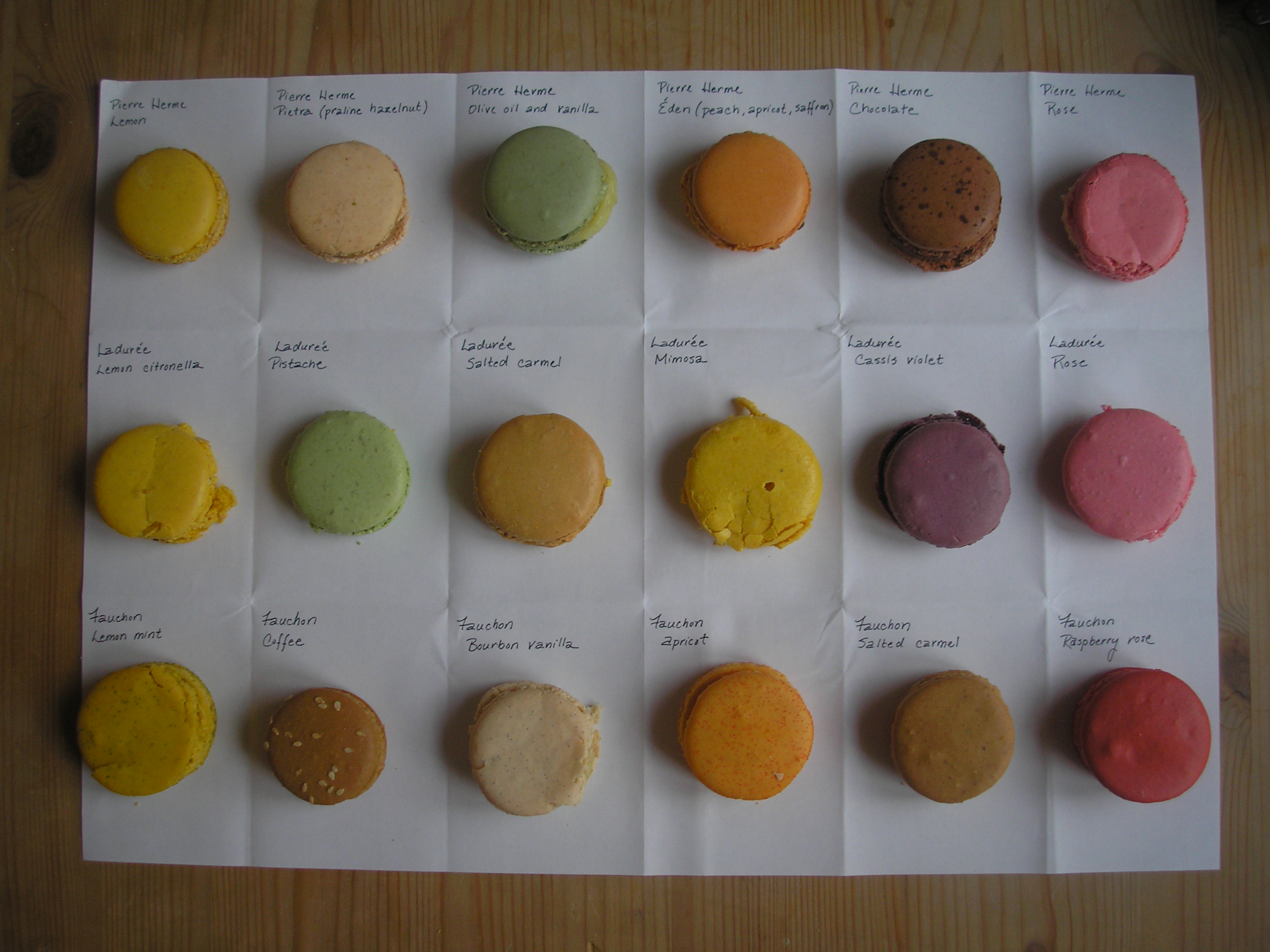
Each macaron was scored by each judge in four categories: looks, flavor, mouthfeel, and inspiration. By “looks,” we mean the aesthetics of the cookie, which is as absolutely important as anything else when you are dealing with this überfussy whatsit. “Flavor” encompasses taste, smell, and fidelity to the original concept (meaning a mimosa-flavored macaron should taste like an actual mimosa). “Mouthfeel” is an excellent word that beer connoisseurs use to describe how something feels when it’s in your mouth. Here, we mean the texture of both the cookie and the filling, that is, how tender and pillowy the combination. Finally, by “inspiration” we mean a variety of things, including creativity, originality, execution, and the generally ineffable “wow” factor of the macaron. Each category could receive up to five points from each judge, thus each macaron was scored out of 40 possible points.
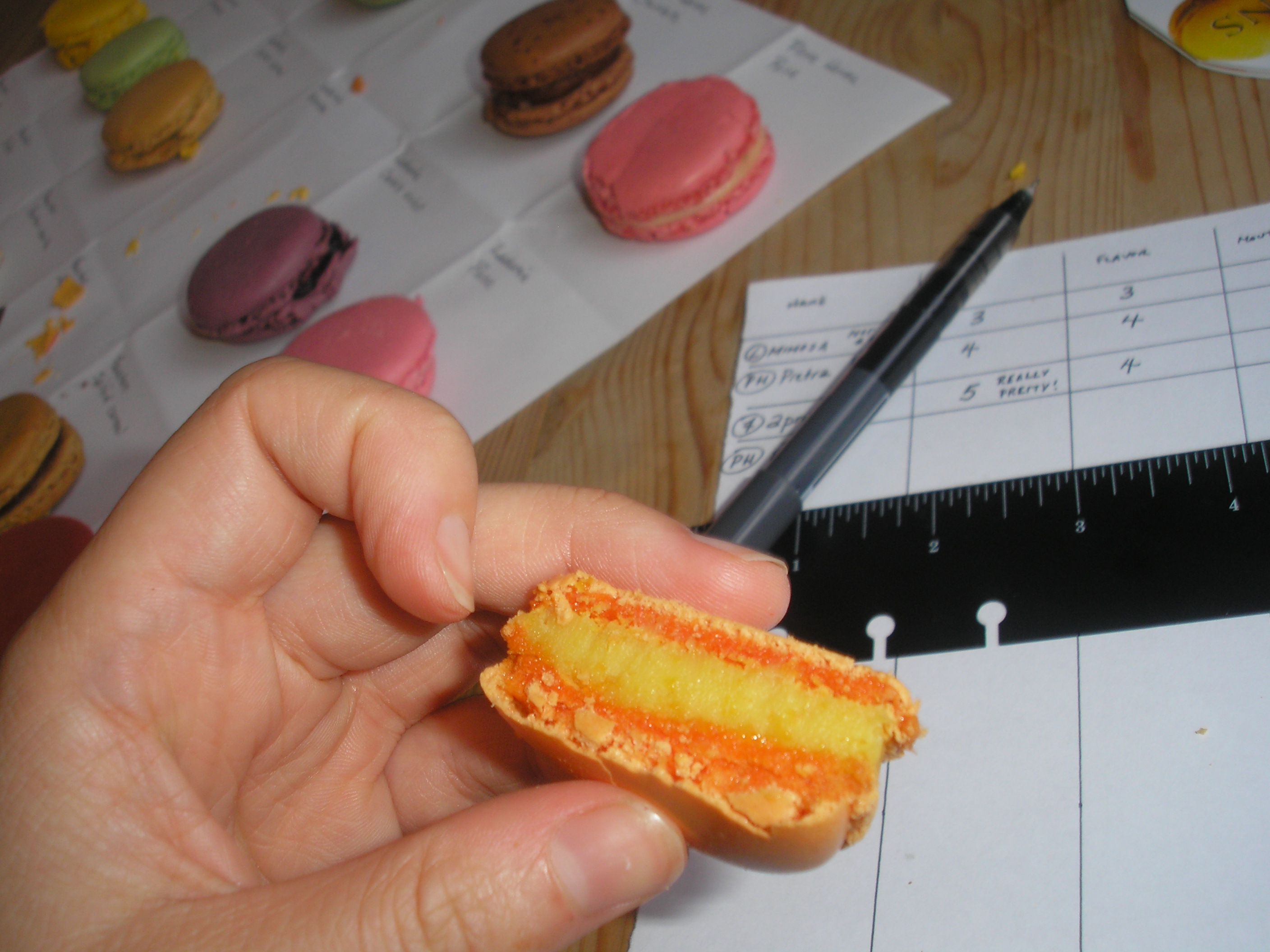
After about an hour and a half of careful tasting, discussion, consultation with M over Skype, and rolling around on the couch moaning in agony about how much sugar we had eaten (okay, maybe that we just me), we arrived at this:

The verdict:
B’s scorecard:

My scorecard:

The final tally for each macaron:

Our individual favorites were the cassis violet and salted caramel at Ladurée, the rose, praline hazelnut and peach, apricot and saffron at Pierre Hermé, and the apricot at Fauchon. I spit out the olive oil and vanilla flavor from Pierre Hermé and the lemon citronella (WHY LADUREÉ, WHY?), as I thought they tasted respectively like handcream and mosquito repelling candles. I discovered that my boyfriend will happily eat my regurgitated cookies in lieu of wasting a buck or two. While the Ladurée and Pierre Hermé macarons were both consistently well-textured to our tastes, we really disagreed about the Fauchon texture. I found their slight crunchiness a welcome contrast from all the pillowy gooeyness, but B thought they were stale.
If you were just a simpleton like me, you’d be content to tally the six scores for each contender, add up to 10 bonus points for in-store experience (retail space, macaron packaging, wait time, staff kindness, general claustrophobia induction, etc.), and call it a day. So for all the simpletons out there, that would mean the following:
Ladurée: macaron score 127 + 1 point for in-store experience = 128
Fauchon: macaron score 121 + 3 points for in-store experience = 124
Pierre Hermé: macaron score 133 + 9 points for in-store experience = 142
Taking additionally into account that Pierre Hermé won each of the individual flavor battles (lemon and rose), Pierre Hermé is the clear winner. Can we have a cocktail now?
Unfortunately, my boyfriend is no simpleton.
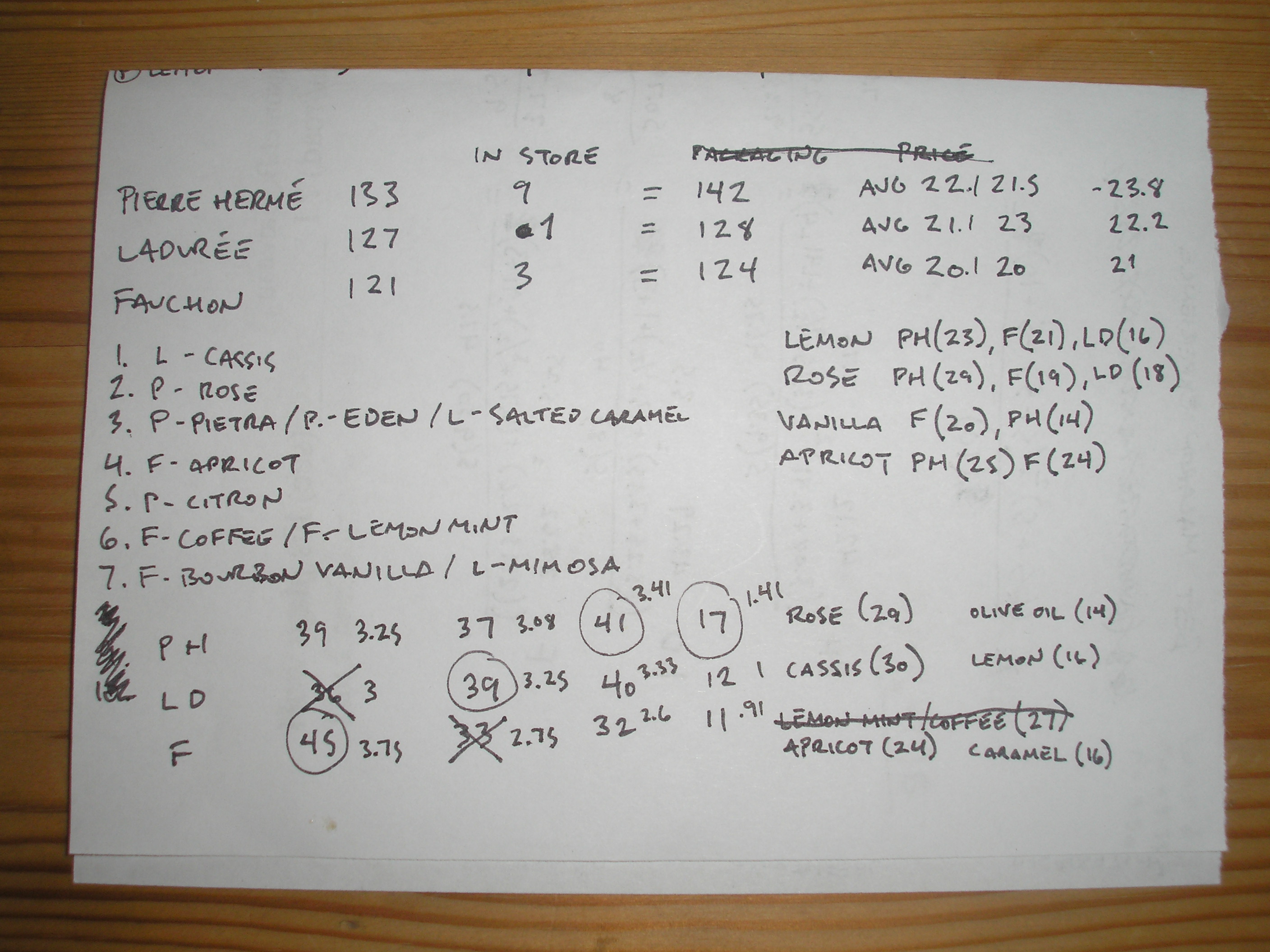

Long after I had eaten all the crumbs and begun complaining about my bellyache, B was still calculating how exactly he wanted to assess our raw data. After much talk of the importance of each category, in-store experience, and rankings in the individual flavor battles, he eventually settled on this equation:
(Ia(Fa+Ma)2+(La+S/2)+T+B)/P = likelihood of enjoying a random macaron from the store
where a is average, I is inspiration, F is flavor, M is mouthfeel, L is look, S is in-store experience, T is number of macarons in top 10 ranking, B is flavor battle wins, and P is price.
Using this (batshit crazy) rubric, Pierre Hermé receives a 7.6, Ladurée a 6.2, and Fauchon a 3.7. While the ranking is still the same, this illuminates the disparity between Pierre Hermé/Ladurée and Fauchon a bit more clearly (as in, don’t even waste your time with Fauchon for macarons). Finally, B notes that according to his calculations (and this is a man who just spent the better part of his birthday evening creating an ultimate Hungerdome macaron equation), Ladurée has better quality (that is, taste and mouthfeel) on average.
As we’ve now crossed over the 1500 word mark, I’ll leave it up to you what you choose to do with this information. I suspect that the classicists and short-timers will still be going to Ladurée, the avant-garde foodies will hit up Pierre Hermé, and everyone will continue to not bother with Fauchon. Me? Well, despite the close race between my old standby Ladurée and Pierre Hermé, my eyes are now open to the delight that is the latter. I’m on pins and needles in anticipation of the release of their white truffle and foie gras macarons. That is, if I’ve recovered from this stomachache and sugar high by sometime this fall.
LEAVING THE HUNGERDOME: PIERRE HERMÉ!
 The Bear-Garden