Category: artsy-fartsy
Contempt and my new color-scheme
 Last night I went to see Jean-Luc Godard’s Le Mépris (Contempt) at La Cinémathèque Française, a place that is all kinds of awesome. It’s housed in an amazing Frank Gehry building, has an incredible museum and library of cinema on the premises, and screens an entirely overwhelming number of films on a daily basis. If you wanted to know ground-zero for an autodidactic approach to becoming a real cinéphile, La Cinémathèque Française is the place. I’ve seen Contempt many times before (how would I know how to do my eyeliner or wear stripes if I hadn’t?), but this was the first time I’d seen it on the big screen and man was it cool. They are showing Contempt as part of a larger retrospective on the work of Alberto Moravia, the Italian writer responsible for many of the most interesting narratives of that era of filmmaking. I’m planning to hit the Bertolucci and the Pasolini screenings next week. I find it is good to have goals.
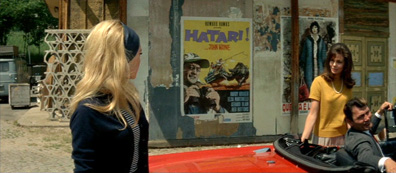
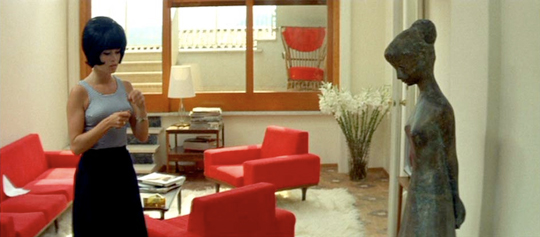
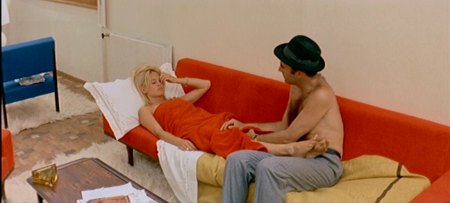
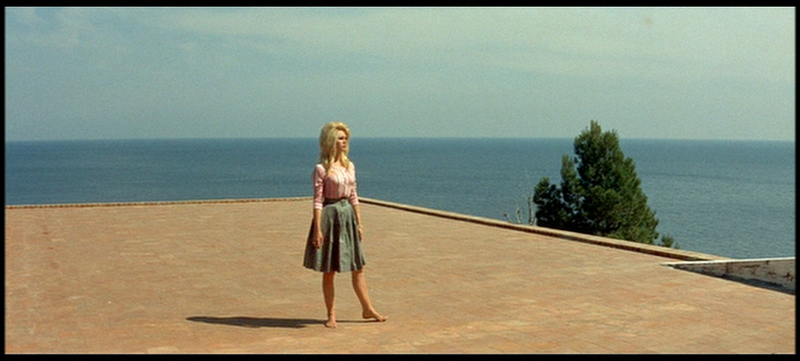
I don’t know whether it is the sudden profusion of bright, blue-sky days in Paris or merely my fatigue with the monochromatic look of winter clothing, but I’ve been starved for some new colors in my life lately. While I had a pleasant recollection of Godard’s gorgeous use of the primary color palette in the film, something about the mustard yellows, cherry reds, and robin egg blues really hit home last night. If you too are needing some new hues in your life, here’s some stills I stole from the internets. Hope they make you feel as swell as I did.
Oh, Audrey
 My friend O is in town for a few days to review the new production of Ibsen’s “Maison de Poupée” (“A Doll’s House”) at the Théâtre de la Madeleine, starring none other than Audrey Tautou. It pays to have friends with interesting jobs, especially when they need a hot date for the theater. While O, an Ibsen scholar of substantial insight, had gotten me amped for the unusual take on Ibsen’s play that were were surely to witness, I’ll readily admit that my interest in the spectacle largely stemmed from my desire to see Tautou in person. It is difficult for a certain kind of American to construct a mental composite of a cool French girl without consulting the tropes laid down by Amélie. Just to get it out of the way: Yes, she is absolutely as gorgeous and tiny and sylvan as you have suspected. Probably more so. It’s much more than the haircut. She looks like she is made of porcelain.
 The Théâtre de la Madeleine is a tiny, mid-1920s structure that allows for a really intimate encounter with the stage. As for the production of “Maison” itself, I thought it was terrific. I’ve been pretty honest here about what a philistine I am when it comes to the theater, but Michael Fau’s vision of the play was funnier, more melodramatic, and more riveting than other productions of Ibsen I have seen. Tautou’s Nora was a mass of frenetic, manic energy, and the racing clip of her anxiety made the climax of the play more psychologically intelligible than I’ve ever seen it handled before. It wasn’t everyone’s cup of (boring) Ibsen tea–the two men next to us threw up their hands in the second act, audibly muttered “Putain!”, and exited the theater. But if you are interested in seeing a radically different, anti-realist take on Ibsen, I would really recommend that you try and snag a ticket to this production. When O’s (much more articulate and insightful) review comes out in the Ibsen journal she is writing for, I’ll try and post it here.
Photos via Théâtre de la Madeleine
Cinéclub: La Filmothèque du Quartier Latin

La Filmothèque du Quartier Latin
9 rue Champollion, 75005 Paris
Métro: Cluny – La Sorbonne
Last night some of my people and I saw a delicious new print of Pasolini’s 1968 Teorema at La Filmothèque du Quartier Latin. I’ve mentioned this cinématheque here before, but it really deserves its own entry. God, I love this place. From what I gather on the internets, La Filmothèque was founded in the late 1960s as part of the Cinémas Action, an excellent group of small theatres on the Left Bank that is now made up of Action Écoles and Action Christine. Following a management dispute in 2005, La Filmothèque splintered off and was renovated in 2006 with quite excellent results. It houses two screens, the 100-ish seat Salle Marilyn and the smaller Salle Audrey. The OCD preschooler in me loves that the two screening rooms at La Filmothèque are color-coded. Everything in Salle Marilyn is red, and everything in Salle Audrey is blue, extending to the Filmothèque’s excellently maintained website. I’m mildly obsessed with the light fixtures in the theatres and fantasize about the day when I can outfit my own home with such baroque loveliness. I have lots of really bourgeois dreams.
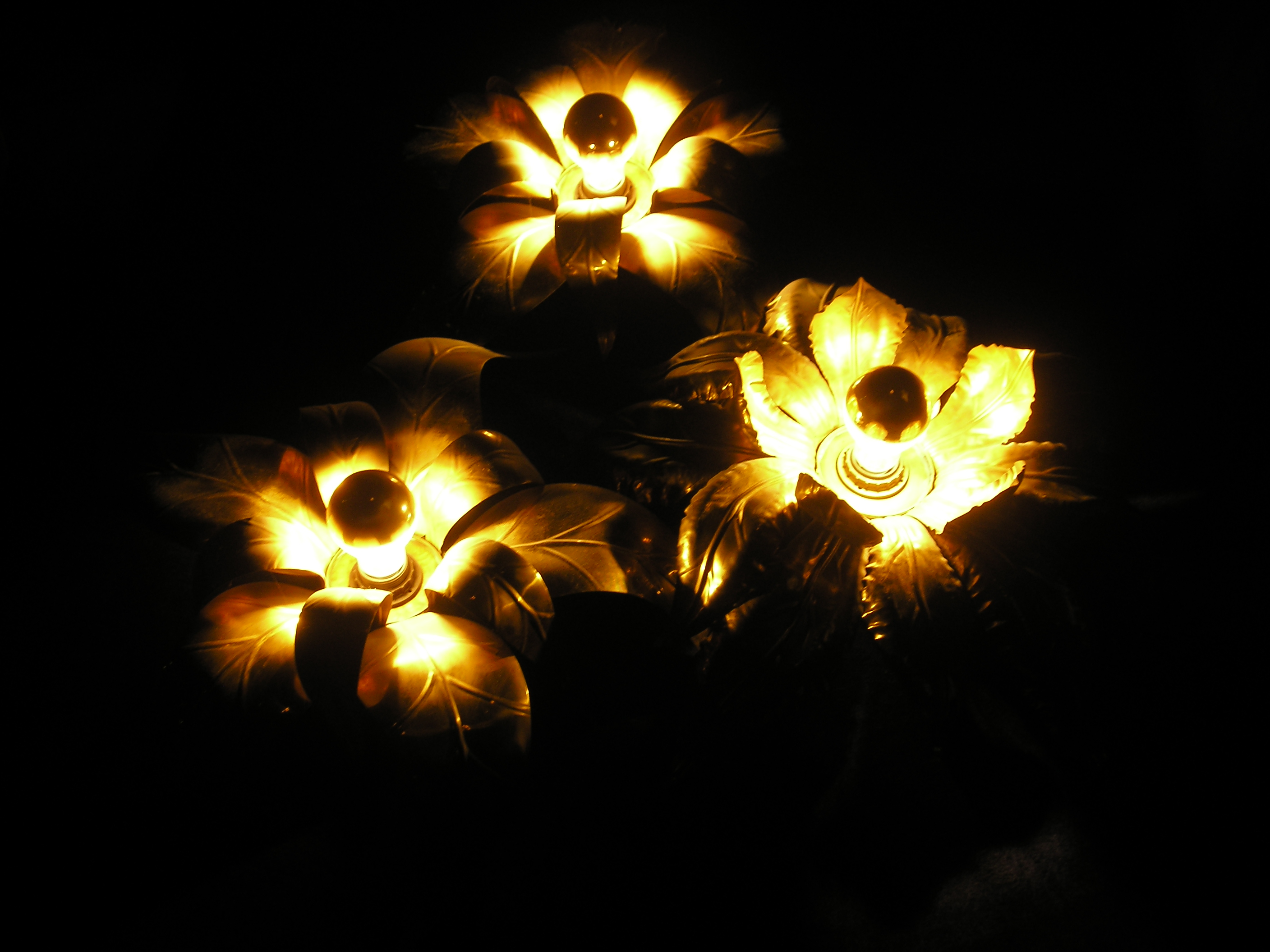 The programming at La Filmothèque is consistently sharp and timely. Like some of the other slick theatres in the area (including Le Champo), La Filmothèque synchs some of their programming with other cultural events in Paris. So to correspond with the excellent Fellini retrospective at Jeu de Pomme, La Filmothèque screened La Dolce Vita every night for a two months (I only went twice, I promise). Something about being in Europe makes me obsessed with Southern California, meaning that I’m compelled to devour Thomas Pynchon novels when living in Paris (weird, I know). In the same vein, I went through a intense revival in interest in David Lynch in the past month. Ever-canny to my longings, La Filmothèque served up an amazing three-week Lynch binge. Likewise, I suspect that La Filmothèque heard that I have a cinéclub and that we are really into Pasolini right now, hence their current screening of Teorema. We had a ball last night, though I suspect we might have been the obnoxious Americans that were whispering too much and laughing too hard. As a sidenote, my angry reader never responded to me, so I’m going to keep writing about Pasolini. It could have been a great love affair, Angry Reader! Where have you gone?! Are you at Accattone right now? We’re going to see Il Racconti di Canterbury tonight, join us!
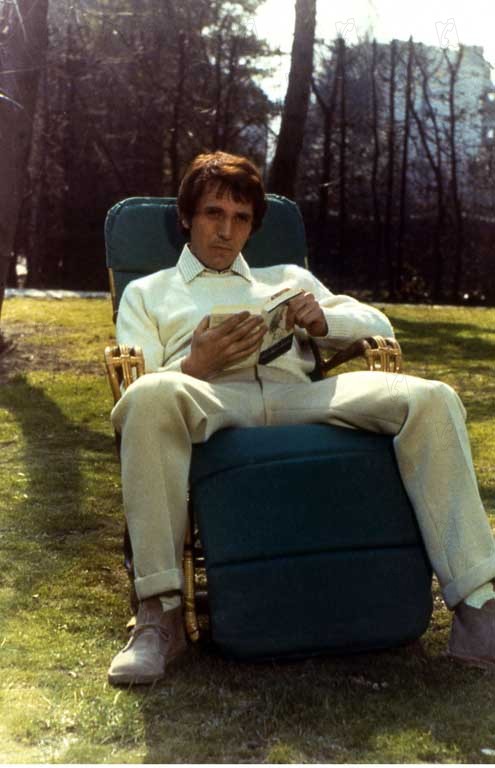 Teorema chronicles a domestic scene turned inside out by the introduction of the seriously sexy Rimbaud-reading Terence Stamp, who enters a wealthy Milanese family and quickly seduces mommy, daddy, brother, sister, and the maid. Stamp’s character leaves as abruptly as he came (ha!), leaving the family to disintigrate in his wake. Mommy starts trolling the streets for young men to screw in ditches, sister goes into a fist-clenching catatonic state and is institutionalized, brother discovers art and becomes a handful of clichés about sublimation, and daddy becomes a train-station stripper who ends up screaming in a desert of volcanic ash. The maid returns to her rural village and goes into a religious withdrawal: eating only nettles, curing children afflicted with measles, levitating above the building for the entire town to witness, and eventually burying herself to weep in a construction site for new apartment buildings. I’m sure that the initial reception of this rabidly anti-Church and anti-bourgeois film was a tad different in 1968, but we thought it was hysterical.
My last entry was titled “Remnants” and I realized that I titled it that because of a passage I especially like from Pasolini’s A Film-Maker’s Life, which I’ve been reading in lieu of doing work. I was thinking about this passage last night when I was trying to explain my deep and abiding love of men with chest hair and I found myself saying, “Well, of course this is deeply Oedipal, but…” I find myself increasingly annoyed by my circumscription of my own autobiography by a certain clinical and critical language. Pasolini obviously felt the same way:
 I’ve never talked about the importance of the family, I’m against the family, the family is an archaic remnant. During my childhood I had certain conflicts with my family whose background was definitely middle-class. My father represented the worst element I could imagine. It’s rather difficult to talk about my relationship with my father and mother because I know something about psychoanalysis. What I can say is that I have great love for my mother. My origins are fairly typical of petty bourgeois, Italian society, I’m a product of unity of Italy as a Republic.
He also obviously had a soft spot for a man with some serious body hair.
Remnants
 A inspected the blog line graph yesterday and noted that as soon as I started writing about him, my readership plummeted. I suggested that this is because nobody wants to read about a do-gooder humanitarian. We agreed that it would probably be best for the blog if I invented a rockstar named Z with whom I can conduct a steamy affair. I worried for a moment that focusing my energy on recounting the various occasions in which Z has done blow off of my naked body before ravaging me in a public restroom might detract from the main purpose of this blog, namely writing about brunch. But A assures me that rockstars are very good at going to brunch. In fact, A insists that rockstars survive entirely on brunch and appetizers. I didn’t realize how well acclimated I was to the rockstar lifestyle! Yesterday I ate a lovely brunch, a plate of charcuterie for dinner, and a bag of hot wings at 3 a.m. Bring me some leather pants. I’m ready.
* * *
 Two nights ago I went to a screening at the Centre Pompidou of Chantal Akerman’s documentary about the German choreographer Pina Bausch, Un jour Pina a demandé, followed by a production Bausch’s 1984 Barbe-Bleue. I’d like to write something semi-articulate about it because it moved me very deeply, but I am coming up against the sense that I lack an adequate vocabulary to speak about dance, or at least this particular type of work. This frustrates me immensely because I feel like I’m dissolving into someone who is moved by everything and has nothing to say about anything. Bausch’s couples in particular dismantled me. This will surely make me sound like a philistine, but I had no idea that such a nuanced version of intersubjectivity could be evoked by dance. Bausch’s work makes shared affect viscerally physical. I kept thinking about this passage in Judith Butler’s Undoing Gender that always makes me weep:
Let’s face it. We’re undone by each other. And if we’re not, we’re missing something. If this seems so clearly the case with grief, it is only because it was already the case with desire. One does not always stay intact. It may be that one wants to, or does, but it may also be that despite one’s best efforts, one is undone, in the face of the other, by the touch, by the scent, by the feel, by the prospect of the touch, by the memory of the feel. And so when we speak about my sexuality or my gender, as we do (and as we must), we mean something complicated by it. Neither of these is precisely a possession, but both are to be understood as modes of being dispossessed, ways of being for another, or, indeed, by virtue of another.
There is a lousy video on youtube of the production of Barbe-Bleue:
Or we could just take this outside
So we were sitting at Han Lim tonight filling ourselves with spicy goodness and I found myself mildly bummed out that we hadn’t tried a new restaurant, not because I don’t like Han Lim, but because I’ve already blogged about it. I was the one that suggested we get Korean food in the first place and shot down another option, making my disappointment especially absurd. And then it became apparent that nobody really wanted to see Eric Rohmer’s Le Beau Mariage at La Filmothèque du Quartier Latin after dinner. M was tired. B asked what the movie was about and I said “I don’t know, French people coupling or something,” and he made a nauseous face. I was bummed about that too, not because I even really wanted to see the movie, but because I haven’t blogged about La Filmothèque yet and wanted to take some photos. Then I realized that I was already writing my blog entry in my head and barely making proper conversation with the two people daft enough to hang out with me on a regular basis. The little conversation I was making was like “bloggity blog blog blog and did I mention my blarg…” And suddenly I thought, whoa Nelly, slow this train down. I’m sorry, B and M, that I’ve been bad live company this week. As my mother said in the comment section, I am like a tick, once I get hold of something, I will not release. A charming personality trait if there ever was one. You two deserve a better dinner companion.
 I was also consumed with how I would respond to an anonymous interloper who tried to post a nasty comment about my entry about Accattone, something about how state funding for small, independent movie theatres that show Pasolini films is symptomatic of everything that is wrong with France. There was also something there about my taste in movies. I was flabbergasted that someone I don’t know could even find this blog. What, were they Googling “something nice about Paris” just so they could shit on it? Five bucks says angry anonymous reader is an expat about two months of bureaucratic hell into his stay in France and he has been alternately begging, swearing, and crying on the phone with France Telecom all day trying to figure out how to get his internet set up and he is now ready to burn the whole country to the ground. Or maybe he moved into a recently renovated apartment and he hasn’t had hot water for two months and he has just taken the coldest shower of his entire life, like so cold that his goosebumps are purple and have tiny goosebumps of their very own, but the contractor has mysteriously disappeared into his Eastern European homeland and just won’t call our angry reader back, even though he has left thirteen messages and offered sexual favors in exchange for help with his boiler. Believe me, angry reader, I know what you are going through. I’m sure you’ve reached the point where you can’t imagine eating another crêpe ever again. But this will pass. Eventually you will have hot water, internet, and a nice kebab place to break up the crêpe doldrums, and this whole phase will seem like a bad dream. But you can’t go posting nasty things on somebody else’s website just because you are having a tough time. Get your own blog! They’re free! I’ll link to you on my sidebar!
I wanted to refute him more articulately, however, so I started researching the French laws that undergird the funding of such enterprises as Accattone and La Filmothèque, both of which are what is formally known as a Cinéma Art et Essai. As a Cinéma Art et Essai, programming must conform to general criteria to qualify for state funding, determined by a national commission composed of people from governmental agencies of finance, culture, and youth, as well as theatre owners, film producers, distributors, directors, and critics. The guidelines that they lay down for programming decisions are laughably broad, from “depicting a way of life not readily witnessed in France” to “potentially enhanced viewing on the big screen.” I can’t think of too many movies that aren’t better viewed on a big screen. In that regard, one might even be able to make a case for The Fast and the Furious as an art film. But these guidelines should be broad, because they allow for independent theatres to approach their programming as a creative act, one that stages a conversation between films from many different genres and eras, not just the rapid-fire commercial schedule that theatres are forced to keep in the United States to keep their heads above water financially. Look, I’m not going to pretend to be an expert on this, nor am I going to argue that the French system is perfect (knowing French bureaucracy, it isn’t). But the point is that many of these cinémas would be in the red without state intervention. In funding these spaces, a variety of French entities, both public and private, are saying that both sensitive film curatorship as well as public access to a diverse range of cinematographic forms are a cultural priority.
I think that we could take a serious cue from that in the United States, especially on a medium that is perhaps most our most definitive and impressive cultural production. I don’t want to turn this into a nationalist argument, but it’s a sad state of affairs that in Paris one can readily watch classic American films that are unavailable in most communities, hell, even most large cities in the United States. It is a truly American oddity that so much money is spent on the production of movies with little to no funding to make the history and avant-garde of that medium available to the public. And, angry reader, should you want to chastise me about the economy and all of things on which money might be better spent besides art and culture and cupcakes, I want to remind you that Avatar has already made like a hundred gagillion dollars. I won’t even argue that we need to devote public funds to such an endeavor. Frankly, I’m rather sick of watching Hollywood movies that are little more than a pastiched homage to niche film genres and listening to their directors wax poetic about how they are scholars of underappreciated and underviewed cinemas (we all know who I’m talking about). I wish that they would put their money, or at least a small percentage of their hundred gagillion dollars, where their mouths are, rather than merely funneling it into another lurching spectacle destined to have no more mark on cinema history than in the sheer vertigo induced by its bottom line.
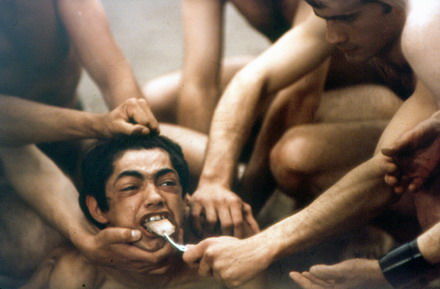
And finally, angry reader, stop fighting it and just go ahead and take yourself to Sunday night Salò. Trust me, you’ll feel better in the morning.
 The Bear-Garden