Category: cinéclub
Or we could just take this outside
So we were sitting at Han Lim tonight filling ourselves with spicy goodness and I found myself mildly bummed out that we hadn’t tried a new restaurant, not because I don’t like Han Lim, but because I’ve already blogged about it. I was the one that suggested we get Korean food in the first place and shot down another option, making my disappointment especially absurd. And then it became apparent that nobody really wanted to see Eric Rohmer’s Le Beau Mariage at La Filmothèque du Quartier Latin after dinner. M was tired. B asked what the movie was about and I said “I don’t know, French people coupling or something,” and he made a nauseous face. I was bummed about that too, not because I even really wanted to see the movie, but because I haven’t blogged about La Filmothèque yet and wanted to take some photos. Then I realized that I was already writing my blog entry in my head and barely making proper conversation with the two people daft enough to hang out with me on a regular basis. The little conversation I was making was like “bloggity blog blog blog and did I mention my blarg…” And suddenly I thought, whoa Nelly, slow this train down. I’m sorry, B and M, that I’ve been bad live company this week. As my mother said in the comment section, I am like a tick, once I get hold of something, I will not release. A charming personality trait if there ever was one. You two deserve a better dinner companion.
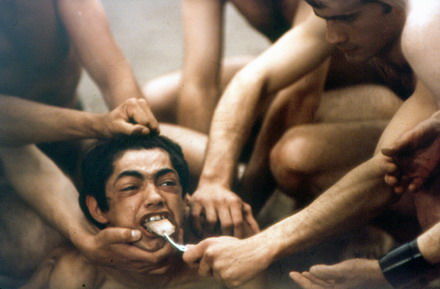 I was also consumed with how I would respond to an anonymous interloper who tried to post a nasty comment about my entry about Accattone, something about how state funding for small, independent movie theatres that show Pasolini films is symptomatic of everything that is wrong with France. There was also something there about my taste in movies. I was flabbergasted that someone I don’t know could even find this blog. What, were they Googling “something nice about Paris” just so they could shit on it? Five bucks says angry anonymous reader is an expat about two months of bureaucratic hell into his stay in France and he has been alternately begging, swearing, and crying on the phone with France Telecom all day trying to figure out how to get his internet set up and he is now ready to burn the whole country to the ground. Or maybe he moved into a recently renovated apartment and he hasn’t had hot water for two months and he has just taken the coldest shower of his entire life, like so cold that his goosebumps are purple and have tiny goosebumps of their very own, but the contractor has mysteriously disappeared into his Eastern European homeland and just won’t call our angry reader back, even though he has left thirteen messages and offered sexual favors in exchange for help with his boiler. Believe me, angry reader, I know what you are going through. I’m sure you’ve reached the point where you can’t imagine eating another crêpe ever again. But this will pass. Eventually you will have hot water, internet, and a nice kebab place to break up the crêpe doldrums, and this whole phase will seem like a bad dream. But you can’t go posting nasty things on somebody else’s website just because you are having a tough time. Get your own blog! They’re free! I’ll link to you on my sidebar!
I wanted to refute him more articulately, however, so I started researching the French laws that undergird the funding of such enterprises as Accattone and La Filmothèque, both of which are what is formally known as a Cinéma Art et Essai. As a Cinéma Art et Essai, programming must conform to general criteria to qualify for state funding, determined by a national commission composed of people from governmental agencies of finance, culture, and youth, as well as theatre owners, film producers, distributors, directors, and critics. The guidelines that they lay down for programming decisions are laughably broad, from “depicting a way of life not readily witnessed in France” to “potentially enhanced viewing on the big screen.” I can’t think of too many movies that aren’t better viewed on a big screen. In that regard, one might even be able to make a case for The Fast and the Furious as an art film. But these guidelines should be broad, because they allow for independent theatres to approach their programming as a creative act, one that stages a conversation between films from many different genres and eras, not just the rapid-fire commercial schedule that theatres are forced to keep in the United States to keep their heads above water financially. Look, I’m not going to pretend to be an expert on this, nor am I going to argue that the French system is perfect (knowing French bureaucracy, it isn’t). But the point is that many of these cinémas would be in the red without state intervention. In funding these spaces, a variety of French entities, both public and private, are saying that both sensitive film curatorship as well as public access to a diverse range of cinematographic forms are a cultural priority.
I think that we could take a serious cue from that in the United States, especially on a medium that is perhaps most our most definitive and impressive cultural production. I don’t want to turn this into a nationalist argument, but it’s a sad state of affairs that in Paris one can readily watch classic American films that are unavailable in most communities, hell, even most large cities in the United States. It is a truly American oddity that so much money is spent on the production of movies with little to no funding to make the history and avant-garde of that medium available to the public. And, angry reader, should you want to chastise me about the economy and all of things on which money might be better spent besides art and culture and cupcakes, I want to remind you that Avatar has already made like a hundred gagillion dollars. I won’t even argue that we need to devote public funds to such an endeavor. Frankly, I’m rather sick of watching Hollywood movies that are little more than a pastiched homage to niche film genres and listening to their directors wax poetic about how they are scholars of underappreciated and underviewed cinemas (we all know who I’m talking about). I wish that they would put their money, or at least a small percentage of their hundred gagillion dollars, where their mouths are, rather than merely funneling it into another lurching spectacle destined to have no more mark on cinema history than in the sheer vertigo induced by its bottom line.
And finally, angry reader, stop fighting it and just go ahead and take yourself to Sunday night Salò. Trust me, you’ll feel better in the morning.
Cinéclub: Accattone
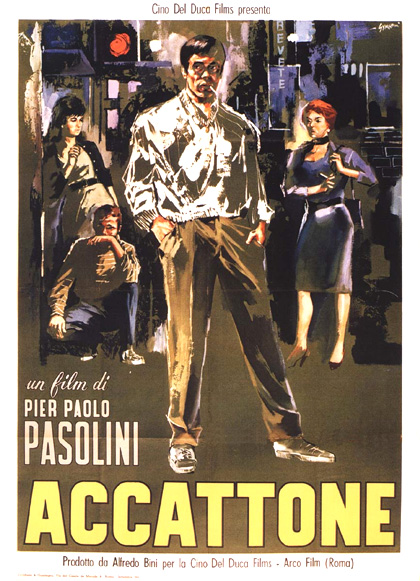 Accattone
20 rue Cujas, Paris 75005
Métro: Luxembourg, Cluny-La Sorbonne
I’ve always liked going to the movies more than doing almost anything else, except perhaps driving around listening to the radio or going out for tacos after lying catatonic on the beach. One of my best friendships is largely founded on that triumvirate of activities. Hang out with me for more than a few hours and I’ll probably suggest we go to the movies, even if it is 8 a.m. on a Tuesday. My taste in film reflects a (perhaps not particularly idiosyncratic) love of the highest of high culture and the lowest of low. I have an especially soft spot for films aimed at the demographic of 14-year-old boys who see movies on opening weekends in large unruly packs. I don’t really think that it gets much better than the Fast and the Furious franchise and I’m largely averse to seeing anything that is going to conjure an emotional response. But I’ve got a long attention span for conceptually-driven films. Does this criteria make any sense? This means I don’t want to see The Road with you—ever—but I will happily watch Inland Empire for a third time. I’ll always pick fart jokes over Shoah tearjerkers, softcore porn over meaningful connections. Titanic and Avatar are the worst of the worst as far as I’m concerned, but say the word and I’ll cancel all my plans so we can watch the entire Terminator franchise tomorrow. Just don’t be too earnest about whatever it is you are doing and I’ll likely be on board. Could this be an effective formulation of my entire aesthetic point of view? I’ll have to think on this.
Living in Paris is a moviegoers dream, as the city is packed, no, HEAVING with small, independently-run theatres that are constantly playing classic films and running various auteur-themed festivals. I’ve been going to an absurd number of movies since arriving here and have managed to cajole a few of my friends into joining me on a regular basis. I dorkfully call this group the cinéclub and we’ve made quite a dent in Italian cinema (Pasolini, Antonioni, and Fellini) in the past few months. Our group cherry was popped, so to speak, on a Sunday night screening of Salò o le 120 giornate di Sodoma (1975) at Accattone. That the members of the cinéclub continued to want to see movies with me, much less hang out with me in any context, is a testament to their collective awesomeness.
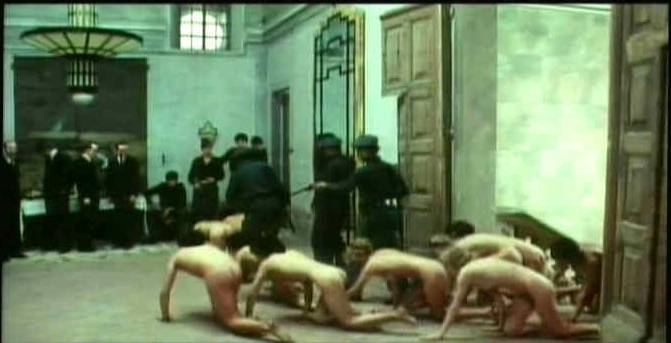
We saw Salò at the well-known, but worse for the wear, cinéma Accattone (aptly named for the Pasolini film). I’d go so far as to claim that Accattone is worst-maintained of the theatres that owe their reputation to the Nouvelle Vague (it was managed by François Truffaut in the 1960s). The empty lobby is much larger than the theatre itself, which has some kind of central of foundational slump that means the seats in the front rows are substantially higher than those in the middle. There is usually only one surly dude on ticket-sale and projection duty, and after appearing visibly annoyed that you want to buy a ticket, he retreats to the projection booth to chain-smoke for the duration of the film, resulting in a fine haze in the theatre itself. The theatre appears to own a few dozen prints and screens them religiously, with little to no variation in the schedule from week to week. Every print I’ve seen at Accattone was more atrocious than the last: Salò was badly damaged and grainy, Il Decameron had extremely fuzzy audio, and the subtitles on La Notte were largely unreadable and the reel broke ten minutes from the end of the film. I expect (and gleefully anticipate) that if I continue going to Accattone, there will eventually be a Buñuel-esque fire.
I say all of this as if it’s a bad thing. It absolutely isn’t. In fact, going to Accattone is such a unique experience, one so wholly removed from the experience of going to the movies in the US, that it is a continual delight. Every single Sunday evening since I’ve arrived in Paris, I could have seen Salò at 9:50 p.m. Better yet, there are people that do. Accattone is one of many small theatres in Paris that receives substantial state funding for its day-to-day operations. In fact, many of these cinémas would be insolvent otherwise. Gripe as I may, at the end of the day, I’m elated to find myself in a place with government funding for weekly Pasolini.
Details: Tickets are 6-8 euro and discounts (student or otherwise) are given at the surly dude’s whim. Unlike the quick turnaround at other Latin Quarter cinémas, Accattone will likely screen the movie you want to see at the exact same time next week, and the week after, and the week after that, so no rush. Don’t go if you are allergic to cigarette smoke or a stickler for print quality.
 The Bear-Garden