It’s really too bad that so much crumby stuff is a lot of fun sometimes

Boy, when you’re dead, they really fix you up.  I hope to hell when I do die somebody has sense enough to just dump me in the river or something.  Anything except sticking me in a goddam cemetery.  People coming and putting a bunch of flowers on your stomach on Sunday, and all that crap.  Who wants flowers when you’re dead?  Nobody.  – J. D. Salinger

I was sad to see that Salinger died yesterday. Like everyone else, I read Catcher in the Rye when I was twelve or thirteen at the recommendation of my parents. Like everyone else, I felt that it captured a particular mood of disaffection and disappointment with the world that only I felt. Like everyone else, I put the book down in amazement and said to myself “That’s me!  That’s how I feel about things!” That feeling fades, of course, with later readings, and I can’t say that I identified nearly as much with Holden when I re-read the book several years ago. I will say I still enjoyed the book immensely and certain parts became funnier as I had myself begun to remedially circulate in a world where people actually grew up in Manhattan and went to Andover. It’s curious that generations of preteens in middle-class suburbs across the US can so effectively ignore the sociocultural observations that Salinger is making about a very specific niche of people. Wait, kids are still reading Catcher, right? Or are they only reading books about wizards and virgin vampires these days? At any rate, while I probably wouldn’t pick Catcher up again today, I’d still put Franny and Zooey in my top twenty any day of the week.

As I poked around on the internet for information about Salinger’s passing, I discovered a strange new facet of Google, which now has this feature that provides a constant feed of Twitters about popular subjects. So as soon as I googled “J. D. Salinger,” I knew that LustyJoe46 has just Twittered: “Catcher in the Rye was all about me, man, R.I.P. J.D.S.”  Fascinated, I watched the Twitter feed for about twenty minutes. I know that this makes me sound geriatric and all of the hip young folks have been on Twitter like for-ever now. An amusing aside:  during a particularly ridiculous moment of Orange County paranoia last year, a young man wandered onto campus wearing fatigues and carrying a gun that somebody construed as a rifle and reported to the police, resulting in a full-fledged campus lockdown with helicopters and newscameras and hysteria-mongering text messages. I was mostly annoyed that my terrific lesson on Melanie Klein was being disrupted. As my students and I waited nervously in our classroom, one kid busted out his computer to go on Twitter to check for updates. I went from fearing my own imminent execution to amazement about this technological black magic in four seconds flat. “So, wait, you can see everything about this topic that ANYBODY is posting on Twitter?! Even if you aren’t their friend? In real time? That’s incredible!” Turned out in the end that the “gunman” was a kid on his way home from playing paintball. I left that incident alarmed mostly by the way that text messaging and Twitter had fanned the flames of a collective panic attack. Technology! It makes us increasingly anxious to live in the world!

Seriously though, I don’t have a Twitter and I don’t really think that I’d be hip to the format. As you’ve probably noticed, I’m a touch longwinded over here. Twitter messages have a limit of 140 characters! I can’t even yawn in 140 characters! I’m not going to throw stones at anybody who Twitters (in fact, most of this week has consisted of me going to talk shit about someone and then realizing that nobody with a blog should ever talk shit about anyone and shutting my big fat mouth). Actually I’m envious that anybody can get out whatever it is they need to say in such a succinct format. What did piss me off, however (you knew this was coming), were the dozens upon dozens of jerk-offs who went on their Twitter feeds to talk about how they didn’t really like Catcher and don’t understand what all the fuss is about or who decided to debate it’s literary merit in the wake of Salinger’s death. To those people I want to say this: I’m sorry that you didn’t read Catcher in the Rye when you were 13 like everybody else because you were instead playing video games or beating off or torturing neighborhood animals. I’m sorry that you waited until you were in your twenties to pick the thing up and only did so because you realized that adults occasionally do this little thing called “read” and you asked your better-educated buddy to recommend some of his favorite books. Maybe you didn’t like it when you read it a decade too late, but you are going to have a tough time coming up with a more important coming-of-age novel for generations of American teenagers. So – – – – off. I’m not censoring myself in that last sentence, I just haven’t decided exactly what four letter word I would put there. Obviously, it is best that I don’t have a Twitter, because I would probably use it as a forum for picking fights with complete strangers.

This was an ugly entry, so I’ll leave you with something better, namely the ever-sagacious Louis Menand talking about Salinger’s legacy in the New Yorker archives. We’re well on our way to this blog devolving into a place where I only post links to New Yorker articles I like. Patience, dear reader, we’ll get there. Patience.

http://www.newyorker.com/archive/2001/10/01/011001fa_FACT3

P. S.  A-topical, but life wisdom none the less:  “If a girl looks swell when she meets you, who gives a damn if she’s late?  Nobody.”
Everything before the Velvet Underground was country music

Last night I saw Vito Acconci (middle name:  Hannibal!  Thank you Wikipedia!) give a really fantastic poetry reading and multimedia talk on his career at the Centre Pompidou.  I can tell you the exact four people who read that last sentence, said “SNORE!” to their laptop screens, and abandoned this blog for the day.  It’s cool.  I’ll catch you guys next time when I’m writing about my ingrown toenails or somesuch.

The event, loosely billed as “Expériences de langage à New York,” began with an opening act of two young New York poets who are basically the kind of guy that I would have never known existed had I not gone to graduate school, James Hoff and Danny Snelson.  I mean that in the best possible way.  I’m so grateful to know boys like this exist.  I feel terrible for women forced to move in social circles where the only operative notions of masculinity are abjectly meatheaded.  Complain as I occasionally may about the stereotype, I’d rather hear some former gifted-and-talented kid turned bowtie-wearing, bird-boned savant wax on about his LP collection in his apartment of well-appointed flea-market furniture than watch football with some baseball-cap wearing townie in a dingy basement any day of the week.  This is all to say that in addition to being startlingly fascinating, Hoff and Snelson were completely adorable.  Their talk was what they describe as “an experiment in performance editing and live data processing,” more or less a free-form associative presentation of things they had found on the internet that they thought were really cool.  They encouraged the audience to ask questions in the midst of the performance and to leave their cell phones on (“the more disruption, the better!”).  They obviously didn’t realize they were in France.  But where they nailed it was in their rhythm: a sporting, interrupting, back and forth between two guys with similar esoteric interests (serial killers, New York experimental poetry, noise music, unauthorized bootlegs) trying to get your attention.  Here’s what their website says about the larger project, Endless Nameless, from which last night’s performance was extracted:

Endless Nameless is a one-year No Input Books publication by James Hoff and Danny Snelson. The project began in November 2008 as Hoff and Snelson began purchasing used hard drives and filling them with a variety of digital objects in text, image, hypertext, sound, and moving picture. Each of these print-on-demand hard drives is a fully functional archive cataloged by publisher and year.  Endless Nameless presents a double articulation of popular data trafficking along with the material histories of our digitally dislocated artifacts.  Cataloging this ‘nude media’ by original source, the book loops these distribution circuits in a nostalgic allegory of publication:  celebrating the publishers while disseminating huge amounts of information.

You can apparently purchase these functional hard drives as archives that represent the labor of these obsessive searching and cataloguing efforts of Hoff and Snelson.  I suspect that one of these might make a fabulous Christmas present for the Neu!-listening, bird-boned LP collector on your own list.  That’s right!  We give Christmas shopping recommendations in January here at Keeping the Bear-Garden in the Background.  Run with it!

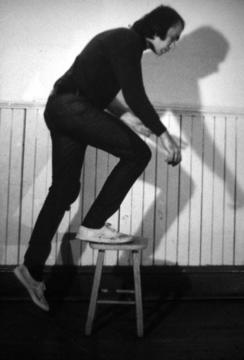
The main event of the evening was of course Acconci, whose work I will admit I knew pitifully little about before last night.  Of course I had gotten the standard three-minute rundown in Art History 101 of Seedbed (1971), the infamous piece in which Acconci lay under the ramped gallery floor of the Sonnabend Gallery and fantasized over loudspeaker about the gallery visitors while masturbating.  I had a more intimate encounter growing up with Dirt Wall (1992), a large-scale installation work at the Arvada Center in Denver, Colorado that replicates the sedimentary layers of soil and rock in the area behind enormous glass panels.  I used to sit on the thing while waiting for youth symphony practice to begin (dork alert!).  But I knew nothing of Acconci’s early work as a poet and was thrilled to listen to him read his poetry, all of which demonstrates his deep fascination with the systemic nature of language.  Like his later performances, installation works, and architecture, Acconci’s poetry all begins with an operative rule or concept.  The aesthetic outcome—be it a poem, an image of a performance, a photograph or video, or even a building—is something of an after-effect.  My favorite of Acconci’s language-based pieces were built on his career-long obsession with Roget’s Thesaurus, which he rhapsodized about at great length as “an idea-loosening system.”  In an interesting anecdote, Acconci talked about how Roget’s formed an important starting point for Seedbed.  Acconci knew that he wanted to be under a ramp on the floor of the gallery, but he had no idea what he would be doing down there.  Browsing through Roget’s, he moved from floor to foundation to undercurrent to seedbed to masturbation.  Again, the concept preceded the act, and reading the thesaurus was a mode for Acconci to  “hypnotize myself into having a starting point.”

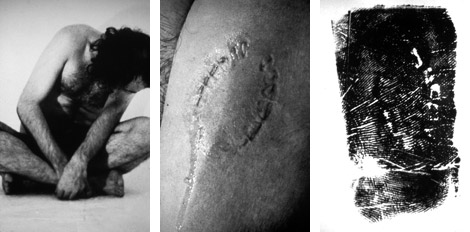
Acconci feels that there are two basic ways of dealing with the self, which always must exist in some kind of pairing if it is to gain legibility in the first place.  In the first pairing, the self is both subject and object (exemplified by Acconci’s works like Trademarks of 1970, in which Acconci bit himself and then smeared the resulting marks with printer’s ink so that they could be used as stamps).  The second type of paring is between the self as subject and the other as object, or as Acconci says, “the I together with the You.”  This understanding is present in Following Piece of 1969,  in which Acconci videotaped his tailing of strangers, following them to places “where I didn’t know I could go.”  Acconci is savvy to the fact that such a piece was dependent upon his urban milieu, “where somebody is always following you, and you are always following someone.”  Acconci noted that following a complete stranger in a small town would be “victimizing” him or her.  It is easy to make the leap from the enabling impersonality of the city to the anonymity of the internet.  But I don’t know if Acconci himself would make that facile comparison.  In fact, he argued last night for an increased personalization of computer technology.  “Treat the computer as a companion or a pet,” he urged.  “Nudge the computer to act with you, not for you.” A welcome recommendation to those of us who often fall asleep with our breathing in tandem with the white light-pulse of our MacBooks. Not me, of course.

Perhaps most amusing was Acconci’s commentary on the most recent phase of his career working as part of an architectural co-operative. Acconci turned to architecture because he was already treating galleries and museums as public spaces, but realized “who was I kidding – a gallery or a museum is never going to be a public space!”  Among his architectural projects, which remain largely unbuilt, is a proposal for the new World Trade Center.  The building is full of holes, a pre-exploded skyscraper.  “A terrorist looks down and thinks to himself ‘We don’t need to bother with that one!  It’s already been dealt with!’”  Cheeky, yes, but the schematics were actually quite mesmerizing, with public garden spaces intermixed in the gaps of the building, turning the notion of a private building with a public front plaza on its head.

Some jerk-off in the audience asked Acconci where beauty figured into his work, and Acconci responded that beauty “had never been a word that meant anything to me.  It seems to me too close to rest.”  Yet his work has beauty in the interstices, and there was something very moving about watching Acconci tear up as he recalled the last scene of L’Année dernière à Marienbad, which he claims to have watched around fifty times.  His unabashed enthusiasm for popular films and music was infectious  (“Everything before the Velvet Underground was country music!”), and it was evident how that verve had influenced younger artists like Hoff and Snelson.

There is a nice interview with Acconci online, if you are curious:

http://www.believermag.com/issues/200612/?read=interview_acconci

Dearest reader

Have I mentioned yet how excellent it is that you are coming here?  Really truly, you’ve made my week.  My mom promises me that she is only clicking on my blog once a day, and even if “once” is actually code for “a dozen or so times,” the math still suggests that other people are actually coming here.  And by the math I mean the WordPress generated stats, and whoa, are they hella addictive.  Everyone should get a blog if only so they can have a line graph of their relative popularity to consult on an hourly basis.  Or not, if you have a job or some other frivolous outlet for your time like that.

Rereading that paragraph, I want to ask:  is “hella” still okay if dripping with ironic distance?  No?  I don’t want to alienate you, dear reader, whomever you are!  If you don’t like “hella,” I won’t use it.  This is a cheerocracy and I take your thoughts on slang seriously.  Not so into Bring It On references either?  Well, dear reader, now you are starting to cramp my style.  Just kidding.  I won’t use “hella” or reference teen comedies if it bothers you.  But “heaving”? Have you jumped on “heaving” yet?  If you haven’t, I suspect that part of the problem is that you don’t know personally the delightful individual from whence this little gem sprung.  The key is her high-pitched inflection on the first syllable.  It seriously kills me.  Maybe I can upload an audio file?  That sounds like it might be difficult.  Perhaps a list of sample sentences to demonstrate how you could incorporate “heaving” into your daily life?  Or you could submit your own!  Look, I know it’s waaay too early in our relationship for me to be making demands of you, dear reader.  You’ve barely decided if you like me yet!  You’re probably just here because you fear slander!  But it would mean a lot to me if you tried on “heaving” for size.  It’s multipurpose, gender-neutral, and British but not affected.  How often does something like that come into your life?  You should thank me.

* * *

Those of you in the know might recognize this beseeching “dear reader” from one of my very favorite books that I would never recommend to you, D. H. Lawrence’s 1921 and 1922 screeds against psychoanalysis Psychoanalysis and the Unconscious and Fantasia of the Unconscious.  Lawrence spends a lot of time in this very bizarre mode of address to his “dear readers,” whom he largely loathes but nevertheless requires as an audience.  He’s a jerk, and it’s one of his jerkiest pieces of writing, and I fully understand that virtually no one is as interested in psychoanalysis AND jerks as I am.  However, if my blithe self-description as a Freudian makes you a wee bit uncomfortable, you might really like it:

With dilated hearts we watched Freud disappearing into the cavern of darkness, which is sleep and unconsciousness to us, darkness which issues in the foam of all our day’s consciousness.   He was making for the origins.  We watched his ideal candle flutter and go small.  Then we waited, as men do wait, always expecting the wonder of wonders.  He came back with dreams to sell.  But sweet heaven, what merchandise!  What dreams, dear heart!  What was there in the cave?  Alas we ever looked!  Nothing but a huge slimy serpent of sex, and heaps of excrement, and a myriad repulsive little horrors spawned between sex and excrement!

I mean, I get it.  Not everybody is as interested in the convergence of sex and excrement as I am.  Or maybe you are just uncomfortable with the vulgar Freudianism that results in a Jersey Shore-style culture of hyper-sexuality and self-promotion (“Everything comes back to sex anyway, so take look at my tits!!!):

If it is a question of origins, the origin is always the same, whatever we say about it.  So is the cause.  Let it be a comfort to us.  If we want to talk about God, well, we can please ourselves.  God has been talked about quite a lot, and He doesn’t seem to mind.  Why we should take it so personally is a problem.  Likewise if we wish to have a tea party with the atom, let us:  or with the wriggling little unit of energy, or the ether, or the Libido, or the Élan Vital, or any other Cause.  Only don’t let us have sex for tea.  We’ve all got too much of it under the table; and really, for my part, I prefer to keep mine there, no matter what Freudians say about me.  But it is tiring to go to any more tea parties with the Origin, or the Cause, or even the Lord.  Let us pronounce the mystic Om, from the pit of the stomach, and proceed.

Oh, David Herbert, I love you.  Even when you punch me in the face, you never fail to make nice a little later on.  Let’s hang out always.  Om.

* * *

Finally, more fan mail!  Just kidding.  However, one M. Starik remarks:  “I don’t mind you using my photos, but does it always have to be in context of the entries tagged barf, solipsism, or funk?”  Point taken, M. Starik.  Your photographs and general bearing in the world in no way reflect these pitiful categories.  From now on, I’ll try to incorporate your work (and the accompanying adjective game!) into more cheerful entries.  Forgive me, divine Miss M.  You really are the wind beneath my wings.

Ready to surrender

I’ve been indulging in a lot of behaviors lately that make me grateful to live alone.  If I had a domestic companion, they would have surely notified the Adult Police by now. I’m pretty sure that 27-year-olds are not supposed to pass out in crumb-filled beds at 4 a.m. after watching eight episodes of The Wire while eating Special K Fruits Rouges directly from the box. 27-year-olds should wake up before noon, brush their teeth at least twice a day, and write their dissertation prospectuses in a timely manner. I’ve been doing none of these things. I like the idea of a S.W.A.T. team-style entry into my apartment in which shouts of “Adult Police! Hands in the air!” are met by my bewildered face, illuminated only by the glow of my laptop and with a dehydrated strawberry stuck to my cheek. After reading me my rights I’m dragged, hands in cuffs and wearing the same dirty Bob Marley t-shirt I’ve been rocking for a week, to the re-education center where I am forced to relearn good eating habits and reestablish a sleeping schedule. Graduate school and its attendant ocean of unstructured time can be perilous when there is nobody around to shame you into getting your shit together. It’s times like these when one of you who cares about me needs to turn me in, for my own good, even though you will be likely be wracked with guilt that you had to turn to the authorities instead of keeping it in the family. Or maybe I’ve just been watching too much of The Wire.

It got me to thinking about how exactly people do manage to cohabitate. I’ve lived alone for nearly five years now and I don’t know how I ever managed otherwise. People joke about their “secret single behavior,” but it always is something cute and manageable to do while living with someone, like plucking the odd hair or eating pickles straight out of the jar.  I feel like I have an entire secret single way of being.  As anyone who has stayed in my company on my turf for more than a few days can attest, I start getting jumpy.  My best friend, upon learning that her week-long visit was on the tail end of my mother’s two week trip to Paris, gleefully cackled and said, “Oh man!  Three weeks of constant contact!  That is going to drive you NUTS!”  I can’t even imagine how I could possibly have someone around when I’m one of the manic work-binges that I have to enter ever few months to stay afloat in my ‘career.’  Don’t significant others disapprove of significant lapses in hygiene? Wouldn’t a domestic partner disapprove if all three meals a day consisted of coffee and microwave burritos?  How about if the “work” area spread like cancer over the dining room table, couch, living room floor, and bed?  Or do people quit doing these things when they are real adults?

Photo courtesy of the bounteous M. Starik

Cinéclub: Accattone

Accattone

20 rue Cujas, Paris 75005

Métro: Luxembourg, Cluny-La Sorbonne

I’ve always liked going to the movies more than doing almost anything else, except perhaps driving around listening to the radio or going out for tacos after lying catatonic on the beach.  One of my best friendships is largely founded on that triumvirate of activities.  Hang out with me for more than a few hours and I’ll probably suggest we go to the movies, even if it is 8 a.m. on a Tuesday.  My taste in film reflects a (perhaps not particularly idiosyncratic) love of the highest of high culture and the lowest of low.  I have an especially soft spot for films aimed at the demographic of 14-year-old boys who see movies on opening weekends in large unruly packs.  I don’t really think that it gets much better than the Fast and the Furious franchise and I’m largely averse to seeing anything that is going to conjure an emotional response.  But I’ve got a long attention span for conceptually-driven films. Does this criteria make any sense?  This means I don’t want to see The Road with you—ever—but I will happily watch Inland Empire for a third time.  I’ll always pick fart jokes over Shoah tearjerkers, softcore porn over meaningful connections.  Titanic and Avatar are the worst of the worst as far as I’m concerned, but say the word and I’ll cancel all my plans so we can watch the entire Terminator franchise tomorrow.  Just don’t be too earnest about whatever it is you are doing and I’ll likely be on board.  Could this be an effective formulation of my entire aesthetic point of view?  I’ll have to think on this.

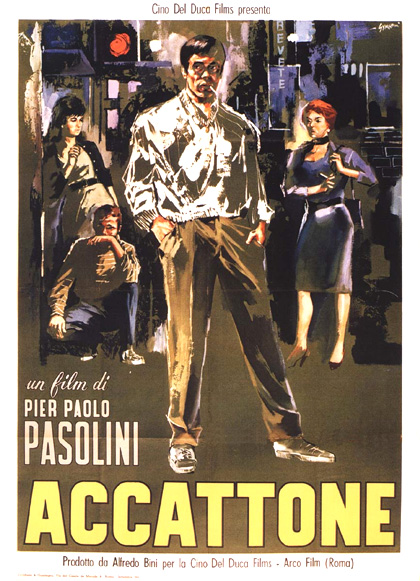
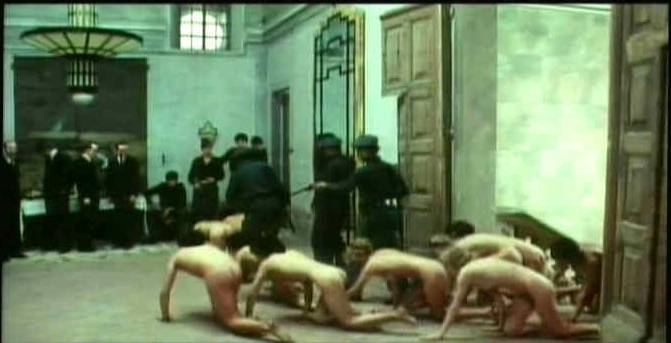
Living in Paris is a moviegoers dream, as the city is packed, no, HEAVING with small, independently-run theatres that are constantly playing classic films and running various auteur-themed festivals.  I’ve been going to an absurd number of movies since arriving here and have managed to cajole a few of my friends into joining me on a regular basis.  I dorkfully call this group the cinéclub and we’ve made quite a dent in Italian cinema (Pasolini, Antonioni, and Fellini) in the past few months.  Our group cherry was popped, so to speak, on a Sunday night screening of Salò o le 120 giornate di Sodoma (1975) at Accattone.  That the members of the cinéclub continued to want to see movies with me, much less hang out with me in any context, is a testament to their collective awesomeness.

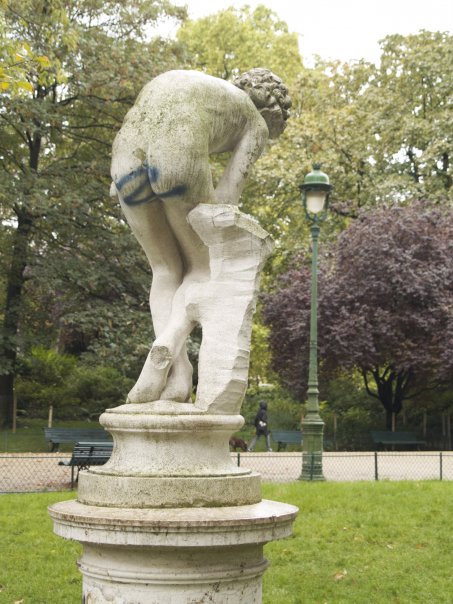
We saw Salò at the well-known, but worse for the wear, cinéma Accattone (aptly named for the Pasolini film).  I’d go so far as to claim that Accattone is worst-maintained of the theatres that owe their reputation to the Nouvelle Vague (it was managed by François Truffaut in the 1960s).  The empty lobby is much larger than the theatre itself, which has some kind of central of foundational slump that means the seats in the front rows are substantially higher than those in the middle.  There is usually only one surly dude on ticket-sale and projection duty, and after appearing visibly annoyed that you want to buy a ticket, he retreats to the projection booth to chain-smoke for the duration of the film, resulting in a fine haze in the theatre itself.  The theatre appears to own a few dozen prints and screens them religiously, with little to no variation in the schedule from week to week.  Every print I’ve seen at Accattone was more atrocious than the last:  Salò was badly damaged and grainy, Il Decameron had extremely fuzzy audio, and the subtitles on La Notte were largely unreadable and the reel broke ten minutes from the end of the film.  I expect (and gleefully anticipate) that if I continue going to Accattone, there will eventually be a Buñuel-esque fire.

I say all of this as if it’s a bad thing.  It absolutely isn’t.  In fact, going to Accattone is such a unique experience, one so wholly removed from the experience of going to the movies in the US, that it is a continual delight.  Every single Sunday evening since I’ve arrived in Paris, I could have seen Salò at 9:50 p.m.  Better yet, there are people that do.  Accattone is one of many small theatres in Paris that receives substantial state funding for its day-to-day operations.  In fact, many of these cinémas would be insolvent otherwise.  Gripe as I may, at the end of the day, I’m elated to find myself in a place with government funding for weekly Pasolini.

Details: Tickets are 6-8 euro and discounts (student or otherwise) are given at the surly dude’s whim.  Unlike the quick turnaround at other Latin Quarter cinémas, Accattone will likely screen the movie you want to see at the exact same time next week, and the week after, and the week after that, so no rush.  Don’t go if you are allergic to cigarette smoke or a stickler for print quality.